homepage
Asia (June 2006 - Aug 2007)
 Australia
Indonesia
Singapore
Malaysia
Brunei
SouthThailand
Japan
Korea
China 1
China 2
Vietnam
Cambodia
NorthThailand
Laos
China 3
Tibet
Nepal
India
Africa
Australia
Indonesia
Singapore
Malaysia
Brunei
SouthThailand
Japan
Korea
China 1
China 2
Vietnam
Cambodia
NorthThailand
Laos
China 3
Tibet
Nepal
India
Africa
Asia 2006
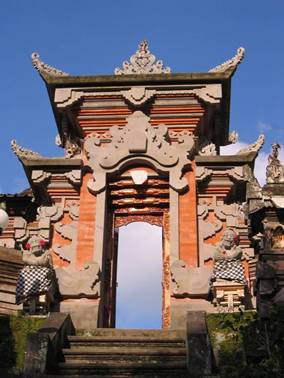


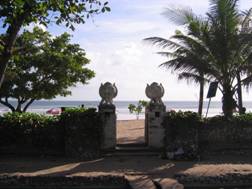

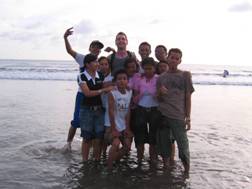
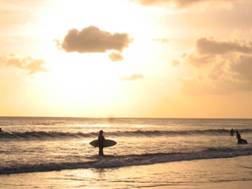
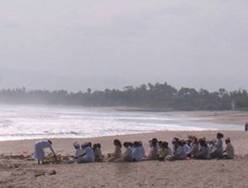

Kuta (Bali). Terrorism certainly has it advantages: it not only keeps the rest of the world pretty clean from Yanks, but it also keeps the Kuta beach very quiet; it's a strange sight when the majority of the people on the beach are Indonesians themselves. The infamous 2002 Bali bombing here in Kuta sure had its effect, the unfortunate locals depending on tourism now have a hard time surviving, even more cynical because the Balinese are Hindus and not Muslims, let alone fundamentalists. I even saw a guy with a t-shirt saying "fuck terrorism".

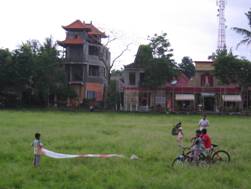
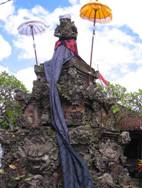
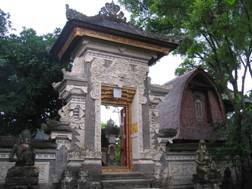

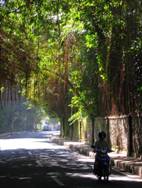
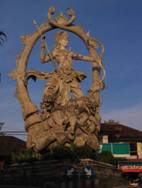

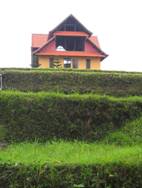
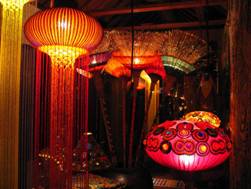
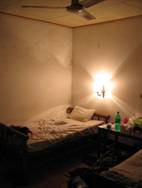


Ubud (Bali). If you look beside all the souvenir shops and the "taxi" touts, Ubud is a beautiful village with loads of temples and arts&crafts.
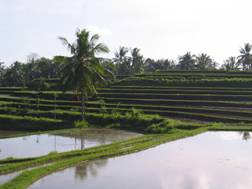
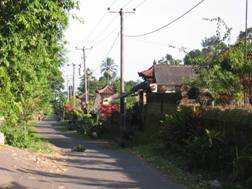
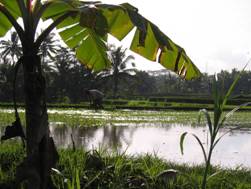
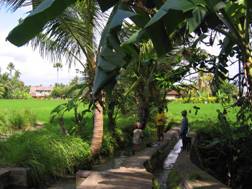
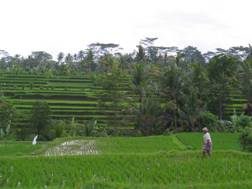
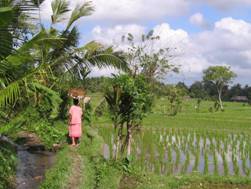


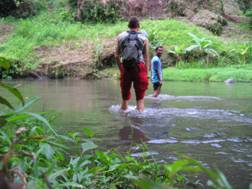
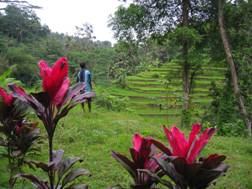
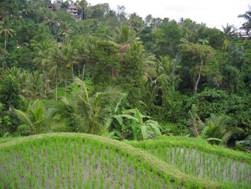


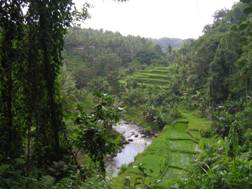

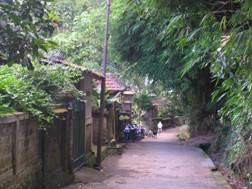

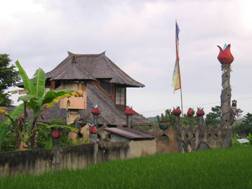

Rice terasses around Ubud (Bali). Lots of people ask me if it is not lonely to travel by yourself. Of course it is, so if you wouldn't feel comfortable by yourself or don't know how to amuse yourself, you'd better get some company. Travelling in company is easier but it will be harder to "immerse" in your environment and make local contacts. For example, when I walked out of the town of Ubud, I ran into someone on the street, and next thing we are on a 3-hour walk acros the beautiful countryside of rice terraces and little villages with Bali-style houses. Next day I am reading a book in a restaurant, and one minute later I am sitting on the back of the waiter's moped on our way to the supermarket, a tour around his family house and a 4 hour conversation about Bali culture.
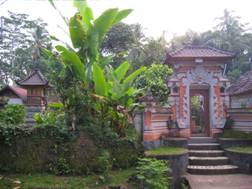

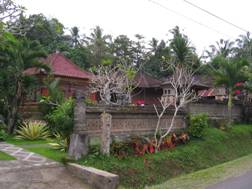
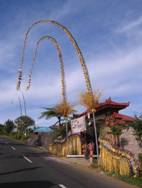
Bali houses. A typical Bali house is a collection of several buildings surrounded by a wall with a beautifull entrance. Within live several families, each in its own house, with a common temple. Most of the ceremonies take place in this family temple, if you'r poor you have a simple one, if your rich it can be a fancy one, see the difference in the first picture. The style of all the houses is very identical, in fact (part of) the house can be new but looks always "old".

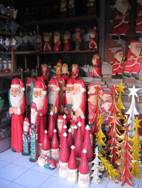
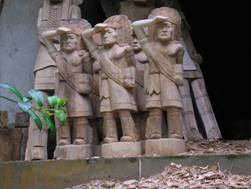


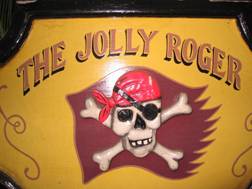


Bali industry. Let's say you have to go a birthday, but don't know what to buy because it's not a very good friend and of curze you're short of time, so you make the fatal mistake go visit a gift shop ("de Xenos"), you buy something you wouldn't like yourself and the receiver surely doesn't realy need, and once the cashier hits the keys, the process is irreversible. A GLOBAL BLEEP, behold! A computer will notify the Dutch central warehouse logistic manager that they got one stupid gift less in stock, and at the end of the month they will send another bleep to the Bali contact for a new container of inferior-style temporary household. So the Balinese start chopping trees, carving wood and painting it. Virtually everyone on Bali seems to be in the business, and when my driver Gus started complaining that the Chinese copy there original Bali designs, I couldn't help wonder what's so typical Balinese about an old fashioned English sign, an American Santa Claus or chief, an African giraffe or an Australian didgeridoo...

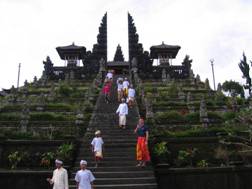
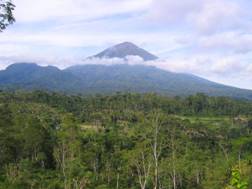
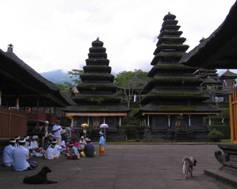
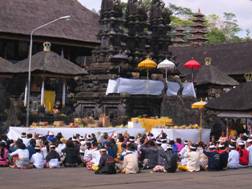
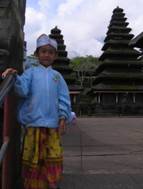




Besakih temple near Gunung Agun vulcano. What? Rodge in a flashy skirt? Oh no, has he suddenly become enlightened and joined the Hindu club?
Nope, I won't believe in God until we shake hands, and may take a while. Or has he turned from metrosexual to transvestite?
Nope, born a boy, stayed a boy. Maybe his pants got robbed while taking a swim?
Nope, I swim with my pants on (because I forgot to bring my swimmers). Then he must be visiting a Hindu temple being obliged to cover his legs with a sarong. Yep, it is that simple. And embarassing, ha ha.


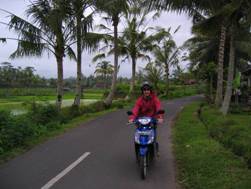


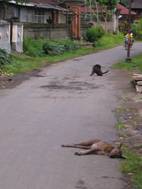

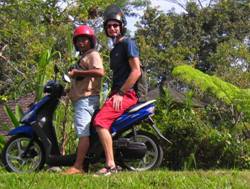
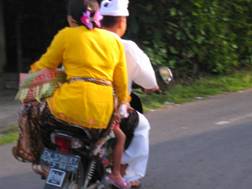
Scootering.Besides a few old men, nobody is biking anymore in Indonesia because they all have a scooter/moped/motor, making the air pollution on the busy streets unbearable. If you want to rent a scooter, forget about minor safety details such as helmets or brakes; the most important feature of your scooter is the horn, it has 3 main functions:
1. To notify the other road users that you are coming to any curve or crossing.
2. To persuade the ubiquitous dogs to abandon there default position in the middle of the street.
3. To greet your ancestors when you pass a cemetery, because you will join them soon since most of the dogs seem to be either suicidal, arrogant, blind or deaf.
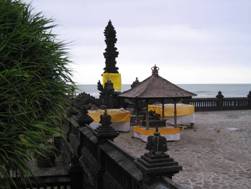
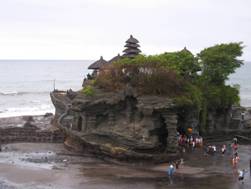


Pura Tanah Lot temple. Dramaticaly situated on top of a limestone rock on the beach.


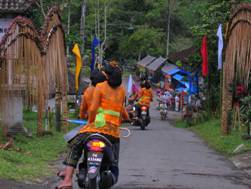
Gunung Kawi and Tirta Empul temples. Velly nice.
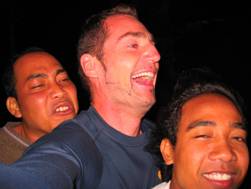

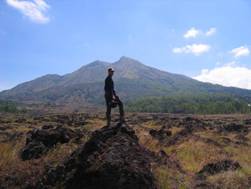
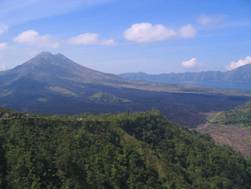

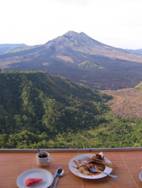
Gunung Batur. After a nightly threesome on a scooter with Made and Zinar, we went to the spectacular Gunung Batur, a small vulcano in the middle of a huge crater, with a lake.

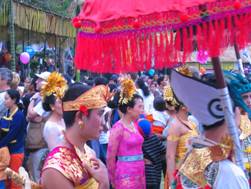
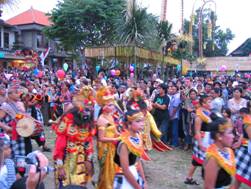

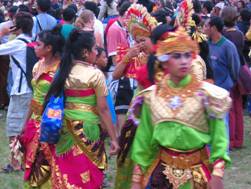

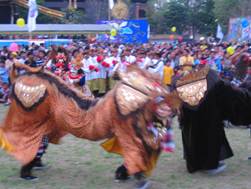
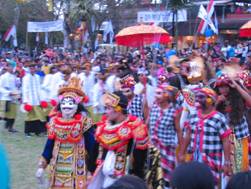


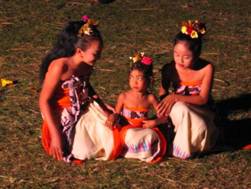

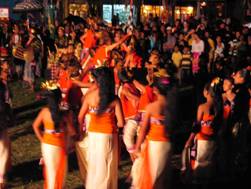

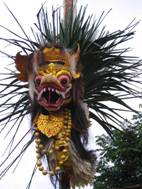
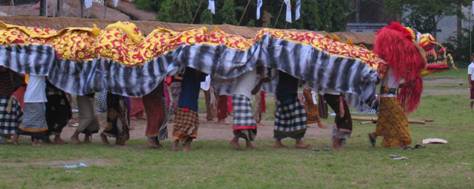
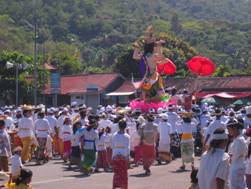
Ubud festival. On the opening of the month-long Ubud cultural festival, every community around Ubud made his own show with dancing, music and very impressive costumes.
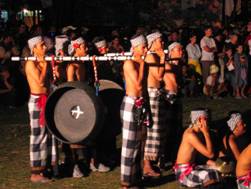
MOVIE: indonesia bali dance.avi


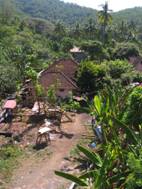
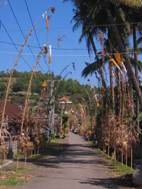
Padangbai. Sni sna snorkeling. Velly good in Indonesia, forget about all the hassle of scuba diving because you can see it all with snorkeling: the most exotic coral, fishes and even turtles.


Lombok. With the ferry I went east to Lombok.

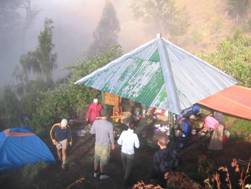

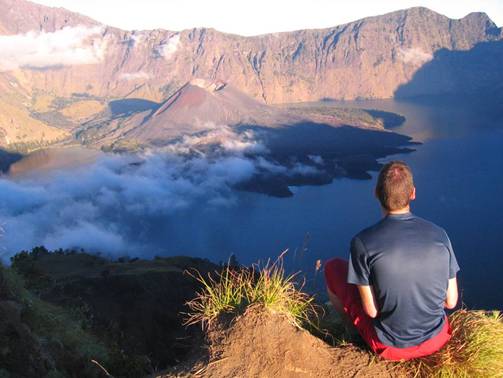


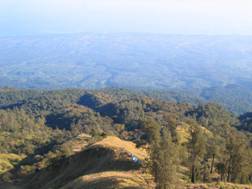
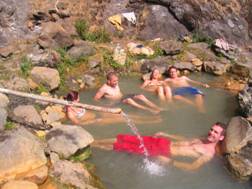


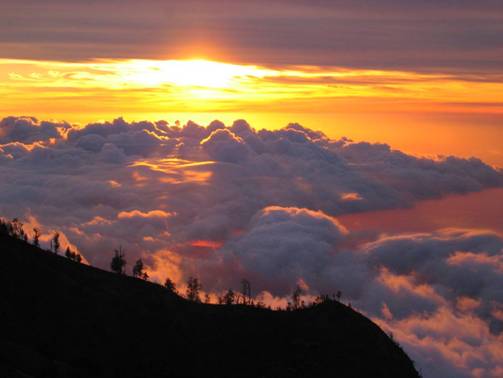


Climbing Gunung Rinjani vulcano. After climbing up to 2600 meter to the huge crater rim, you look down onto an enormous crater lake with a little vulcano in the middle, an unforgetable sight. Next to the crater rim are hot springs to wash the sweat off.
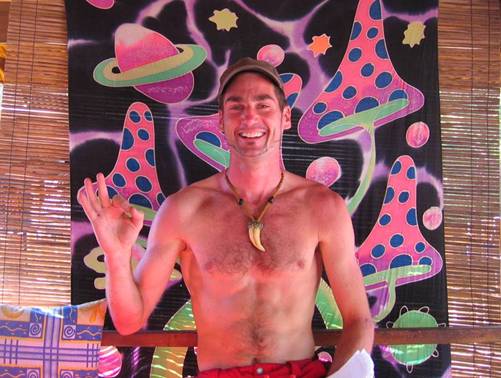


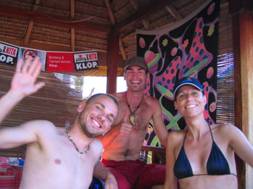
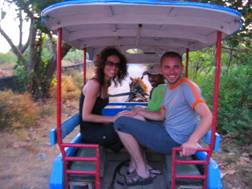

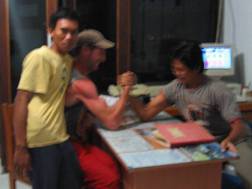

Gilli Trawangan island. This island is so tiny, you can walk around it in an hour. Since there is no police on any of the Gilli islands, people do all kinds of things that are forbidden in the rest of Indonesia, ha ha.


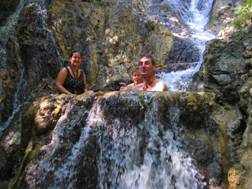

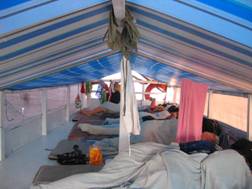
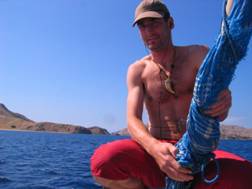
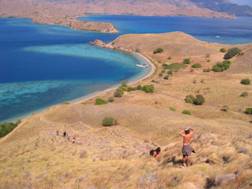
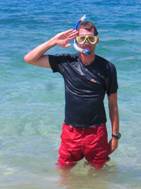

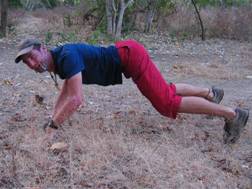
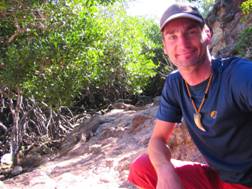
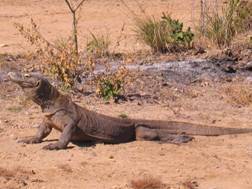
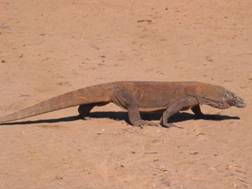


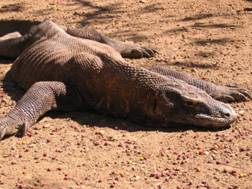
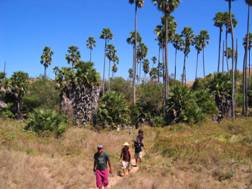
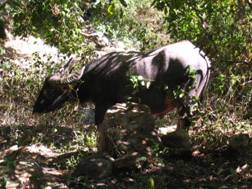

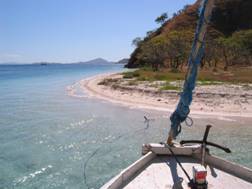
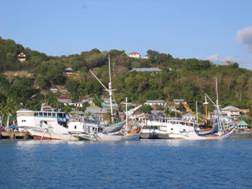


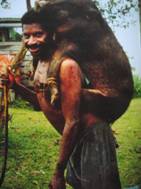
on boat from Lombok to Flores. On a four day boat trip, we visited several small islands to trek and snorkel.
Higlight was the isles of Komodo and Rinca, home of the biggest lizard on earth, often called "the Komodo dragon".
In the old days they would bring a goat to feed them, but some whimpy tourist must have objected so now you have to trek the island to search them, only guarded with a thin V-shaped stick.
It was mating season so they were hiding in the bushes having fun, but fortunately we could see some ugly lazy ones. Post coitum omne animal triste est. Their mouths are full with nasty bacteria, and when they bite a deer, pig or buffalo, the poor victim will slowly (up to weeks) succumb of the infections. Yakky.
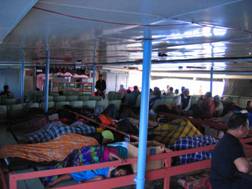

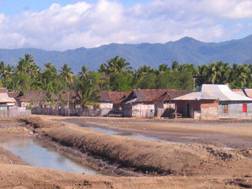
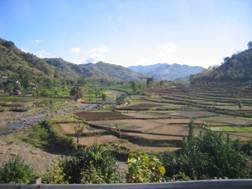

Sumbawa. Across Sumbawa with ferry-bus-bus-bus-ferry-bus return to Bali.
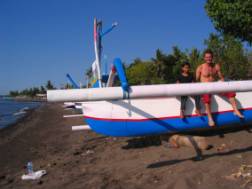

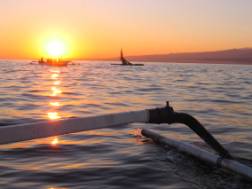


Diving near Lovina. Most reefs in Indonesia are so shallow that you can see everything by snorkeling, so diving is not much use and a lot of hassle. Nevertheless, one has to maintain ones skills.

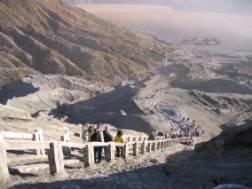
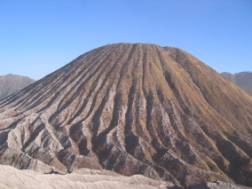
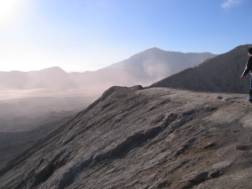
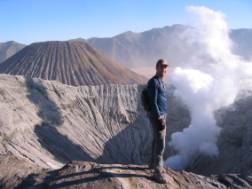

Gunung Bromo vulcano. Nice but awfully touristy, the only vulcano I have ever seen which has concrete stairs up the crater rim. Moreover, everyone drives up to it in a jeep and climbs halfway with horses, while it's all an easy and short walk, ridiculous. But I forgot all this nonsense as soons as I met an interesting German on the other side on top of the crater rim, where we had an unforgetable conversation of an hour about Budhism and related stuff.

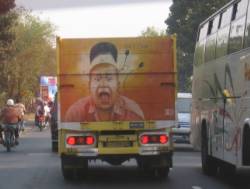

Java. "Indonesian people are not very nice", my Indonesian colleague said to me when I left, and I'm sorry to say that he is often right. Of course I have met a lot of very nice Indonesiands, but it seems as if almost everyone in the tourist industry wants to scam you, I have never heard so many lies in my life. On Java it's even worse, even the Balinese warn you. Exaggerated? Check out my first two days on Java:
- On the first bus trip on Java, I was triplecharged;
- On the second bus trip, my luggage was suddenly pulled out of the bus into a tour agency to try to sell me a tour;
- On the third bus trip in the night, halfway up the mountain, the driver said he was not going any further because he was "bankrupt" since there were not enough passengers, so we all had to pay a lot extra (but he ment only me of course, the tourist). I said I would wait just like the rest and took a nap, and after half an hour he wasn't "bankrupt" anymore, pure magic, and we continued.
- On top of the mountain, the hostal served me an apple juice half filled with dishwater (no joke);
- Next morning, the hostal didn't wake me up to visit the vulcano before sunset as promissed (probably because I didn't book their jeep);
- On my way to the vulcano, the horsemen sent me the opposite way in the dark (probably because I didn't use their horse), I can still hear them laughing;
- We had to wait two hours before the bus left, because at first the driver was taking a shower (huhhuh) and later because they had to refill the airco (huhhuh);
- We finally left, but the driver stopped to grease the bearings;
- The absolute higlight of the day was when the driver bumped into another car and the victim driver snatched our car keys to have a better bargaining position;
- One hour before we would finally reach our destination, our driver decided to go to a garage to change the engine oil, nice timing;
- When we arrived, the hotel receptionist said all rooms were occupied except for the most expensive one. A full house sounds very convincing in times of earthquakes and tsunamis.
And I probably have forgotten the minor ones. But none of these things really bothered me because I had a much bigger problem:
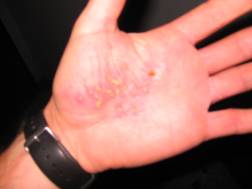
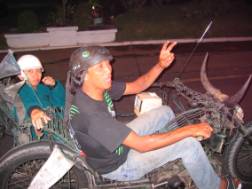
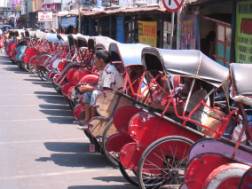
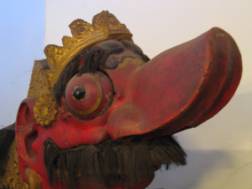


Solo in Solo. When I was three weeks old, I had a serious lung infection which eventually made my head turn blue. I was put in an oxygen tent, the doctor told my poor parents I probably wouldn't make it to the next day, and the hospital priest gave me a quick baptism so that at least my soul would be saved and end up in heaven. However, I wasn't welcome in heaven, and since you can't sent an innocent baby to hell, they decided to send me back, and my poor parents were stuck with me for the rest of their lives. I had a second baptism with all my family present, and this double blessing has made me a very lucky guy in life: I am never sick, I haven't missed a single day of my life in school or work because of sickness, except for lots of accidents. My body has its limitations however, and probably a lack of sleep and food in combination with dirty water gave me a strange infection: when I woke up the day after diving, my hand ached and it was completely infected, yak! Then I made the mistake to go to Java and do one more vulcano, and in the bus afterwards to the city of Solo I suddenly saw that the infection was rapidly advancing onto my other hand and my face. Fuck, what kinda shit is this, and how can it spread so fast? After a strenuous bus trip, I got into a decent hotel (the first one in Indonesia with hot water), took care of my wounds, fortunately I carried antibiotics, and fell asleep exhausted, hoping that the next day I wouldn't have to go to a hospital. When I woke up, the double blessing had worked again, ha ha.


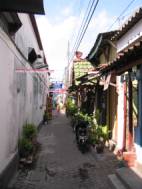


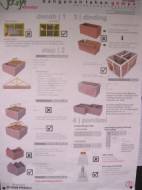
Yogyakarta. A nice city in the centre of Java, famous for its batik paintings, of which I bought way too many. As if Indonesia hadn't been struck enough by bird flu and the 2004 tsunamie, this year added some dengue outbreaks and mudflows, and Yogyakarta even got some more: in May an earthquake who killed about 5000 people, and in July a tsunami on the beach of Pangandaran who killed another 500. A few doors from my guest house the mosque collapsed and a was already being built, and in the streets were posters with instructions how to built an earth-quake proof house.
Most of the Indonesians are muslims, but they are not as strict as in the Arab countries, and they are quit intermingled with the christians and hindus, they always speak about being one big family. Actually, my hostal keeper in Yogyakarta was christian and his wife was muslim, they solved it by simply marrying twice, it was no problem as long as both families agree and nobody tells the government, ha ha.

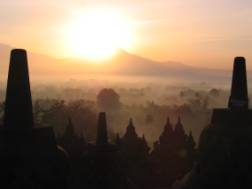


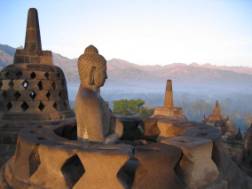


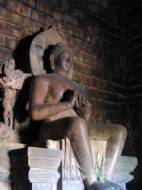
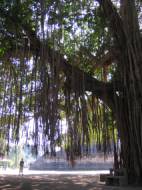
Borobudur temple. This huge Buddhist temple near Yogyakarta makes a beautiful scene at dawn.
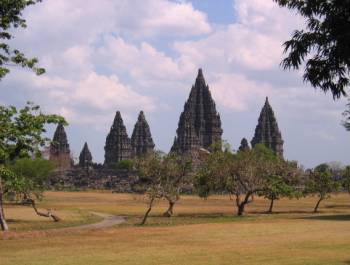

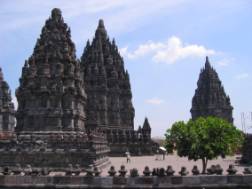


Prambanan temple. Also near Yogyakarta, the impressive Hindu temples of Prambanan, unfortunately severely damaged by the recent earthquake and only to be inspected from a safe distance.

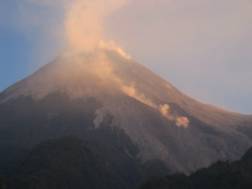

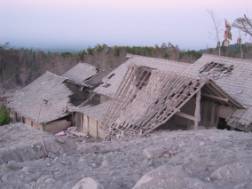

Gunung Merapi vulcano. The recent earthquake also awoke the sleeping vulcano of Gunung Merapi, and at the moment it was still spilling lava (see bad picture) which you can see and hear coming down the mountain, very spectacular. At he base of the mountain everything was covered in a thick layer of ashes, houses were destroyed, and new canyons were made.
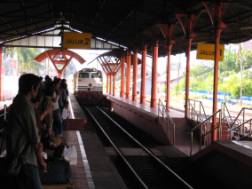
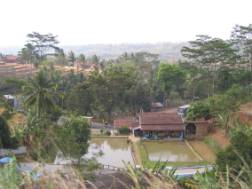
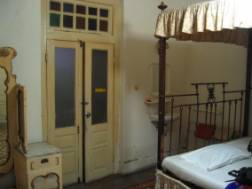
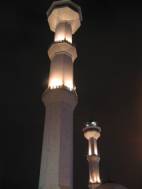


Bandung.As the majority of Indonesians cities, it is just very busy, noisy and dirty. Only interest were some art-deco buildings, very strange to find them in this part of the world.


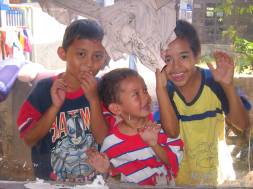
Bogor. A Dutch professor once founded the famous botanical gardens in Bogor. Several times on Java and Sumatra I was being interviewed by English students to practive their pronunciation, and in Bogor I also met an English teacher; some time later I found myself in the crazy situation of helping him with his English pronounciation in his humble house in backdoor Bogor, while his wife was watching Bollywood movies and neighbourhood kids were curiously looking through the window to check out the Mister.

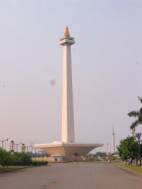
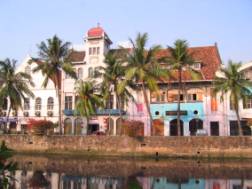

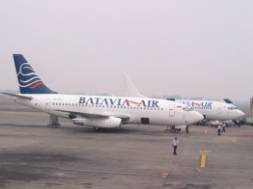
Jakarta. By far not as dirty and noisy as expected, however hardly anything interesting to see, but I had a lot of fun with Max from Leende.
From Java, I took a domestic flight to the north of Sumatra.


Dutch colonial remains. There are hardly any remains from the times that Indonesia was a Dutch colony, except for very few old buildings and:
- lots of words in the Indonesian language such as "knalpot", doorsmeren", "koelkast", "bankroet", etc.;
- the availability of typically Dutch foods such as "hagelslag" and "speculaas";
- bakeries are often called "Holland bakery", allthough their bread doesn't even resemble Dutch bread. The wholegrain Dutch bread is the thing I miss most of the Dutch food during travel, together with the "frikandel speciaal";
- an 81 year old guy in Parapat who still speaks Dutch, because he learned it at school before WWII, but had forgotten some because the Japs ordered everyone to burn their Dutch books.
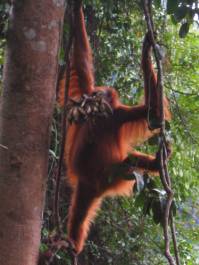
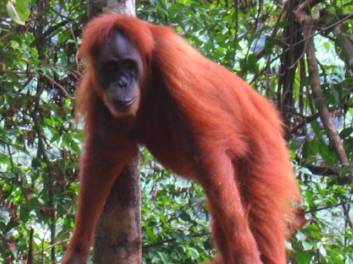

Bukit Lawang orang-utan rehabilitation centre. In the jungle of Sumatra and Borneo live a couple of thousand orang-utans. At this site they are being re-introduced into the wild and these semi-wild primates can be easily spotted.


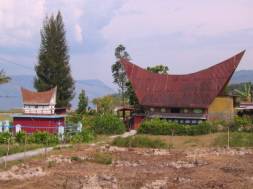
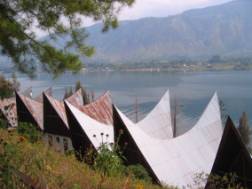


Lake Toba. Some 74.000 years ago, a supervulcano blowed a giant crater in Sumatra, and threw enough ashes in the air to cause a 7 year "winter", which decimated the world human population to just a few tens of thousands. The crater filled with water to make lake Toba, the biggest lake of SE-Asia with a huge island in the middle. The next supervulcano due to bang could be Yellowstone in the US, and that one is a lot bigger, so have fun while you still can!

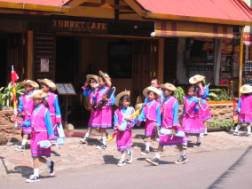

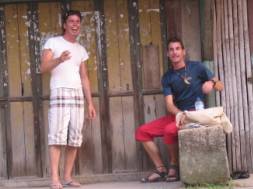
Bukittinggi. One of the best places of Indonesia so far, very beautiful scenery and relaxed people, and here I met Jeanette from Schaesberg.
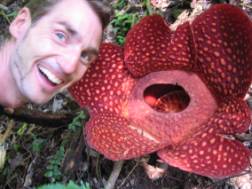
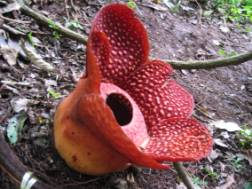

The giant Rafflesia flower. The largest flower in the world, up to 1 meter, unfortunatley a lot smaller in the dry season.
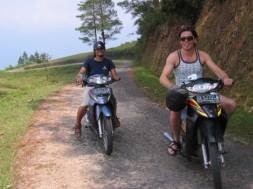

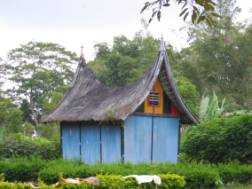
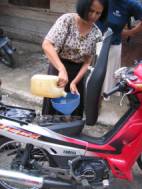


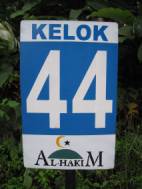
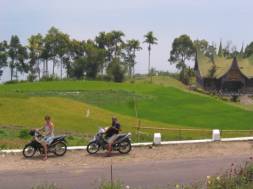


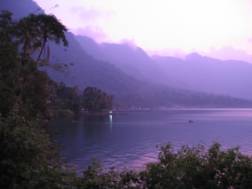
Danau Maninjau lake. On a moped, together with Dewi from Gent and of course Jeanette, we enjoyed the scenery on our way to the Danu Maninjau lake, another giant vulcano crater lake which you can ride around. But the best thing was the descent into the crater on a road with 44 hairpin curves.
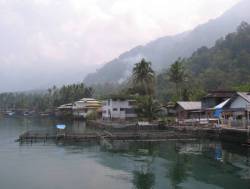
MOVIE: indonesia sumatra dance.avi
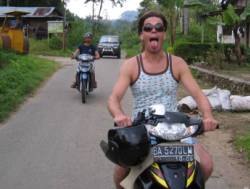
MOVIE: indonesia moped.avi

June 25-30: Kuta (Bali)
July 1,2: Kuta (Bali); 3-18: Ubud (Bali); 19,20: Padang Bai (Bali); 21,22: Gunung Rinjani vulcano (Lombok); 23: Senggigi (Lombok); 24,25: Gili Trawangan (Lombok); 26: Gili bedil (Sumbawa); 27: Pulau Moyo (Sumbawa) 28: near Komodo; 29: Labuanbajo (Flores) 30: Sumbawa; 31: Ubud (Bali)
Aug 1: Ubud (Bali); 2: Lovina (Bali); 3: Gillimanuk (Bali); 4: Cemoro Lawang (Java); 5,6: Solo (Java); 7-10: Yogyakarta (Java); 11: Bandung (Java); 12: Bogor (Java); 13,14: Jakarta (Java); 15: Bukit Lawang (Sumatra); 16: Parapat (Sumatra); 17,18: Tuktuk at Danau Toba (Sumatra); 19, 20: Bukittinggi (Java); 21: Danau Maninjau (Sumatra);

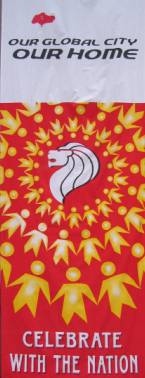

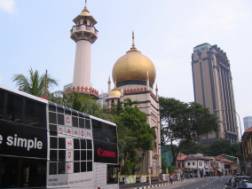


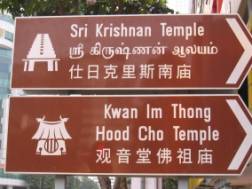
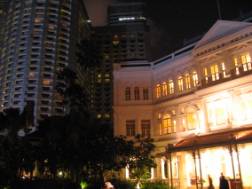
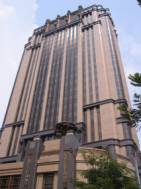


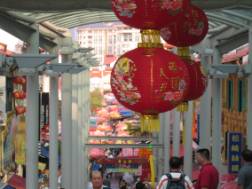


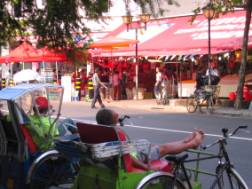

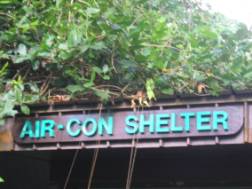
Singapore. "Ding dong, mind the gap". A gap it is indeed, from poor Indonesia (with its bamboo cabins, horse carriages, squat toilets, scoop showers, bad service and dirt everywhere) to the clean and modern Singapore (with its skycrapers, metro, aircon, cleaniness, good service, and.. my first hot shower in two months!).
Singapore is a city state on tiny island next to Malaysia, a former old English colony and trade port, and now a truly global city, a strange mix of mainly Chinese with some Malaysians, Indians and Europeans. You can find a Chinese temple next to Hindu one, a sky skraper next to an Anglican church, an Eglish double-decker bus in front of a mosque, etc. Eyecatcher is the Esplanade with a concert and theater hall each in the shape of half a Durian fruit.
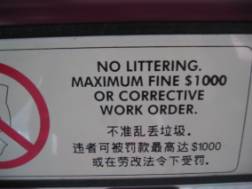

Nanny state. Singapore has made it in no time from a 3rd world country to prosperous modern city, .

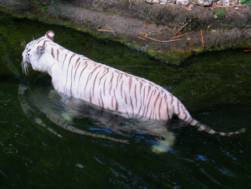

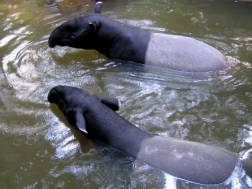
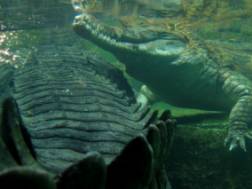


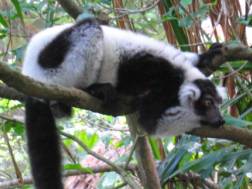


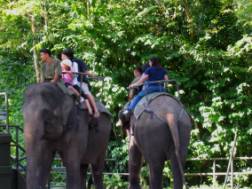

Singapore zoo. You can save yourself a lot of expensive and uncomfortable jungle trips by going to the excellent Singapore zoo: it features white tiger, white rhinoceros, heaps of primates, and even the rare Komodo dragon. Since Singapore is right on the equator, all the tropical animals can easily be spotted sunbathing. Not so nice were the hassle with some animals: you can make an elephant ride or take a picture with an orang-oetan or snake. Next to the zoo there's another zoo which opens up after dark to see night animals, very spectacular if 1 meter wide bats flap their wings right over your head.

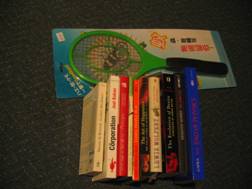

Shopping. Singapore is famous for its shopping mail, and I took the benefit of the largest book shop in South East Asia to stock up on some books, and I finally found "the best invention of the last century": the electrical mosquito killer. The best is not always simple, but simple is always the best.
Aug 22-27: Singapore


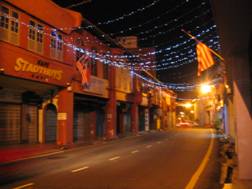
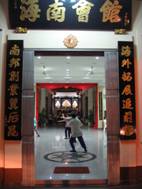
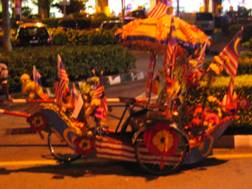
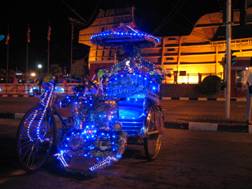

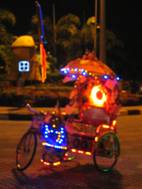
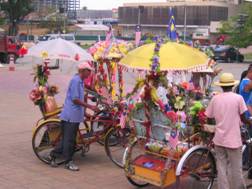
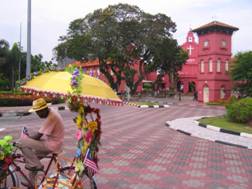
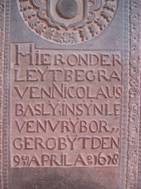
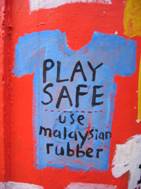


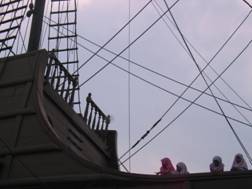
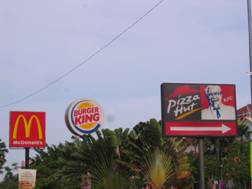

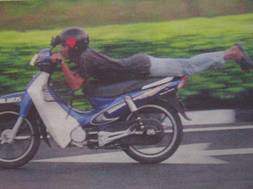
Melaka. A successively Portugese, Dutch and British collony, with a nice chinatown, a Dutch graveyard, and many outragously decorated biketaxi's.


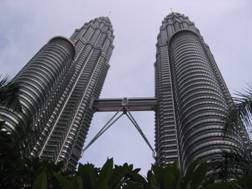


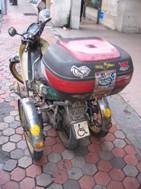

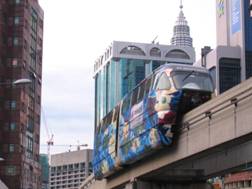
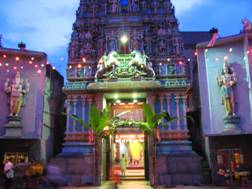
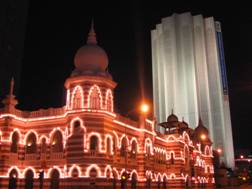


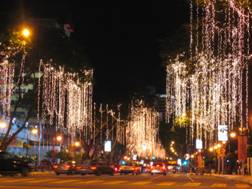
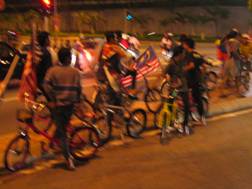
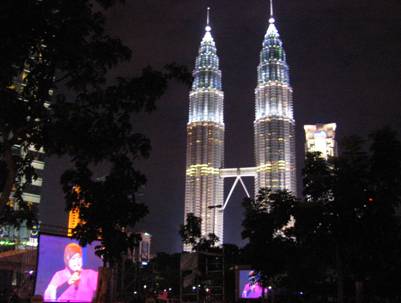
Kuala Lumpur. South East Asia's booming city with the icon of Malaysia: the Petronas Towers, the world's 2nd highest building. Normally I don't fancy skyscrapers because they look boring without any human scale, but these ones are very nice.
Malaysia is mainly moslim but has a lot of Chinese and Indians, so every Malaysian city has its Chinatown with some temples, a little India with some temples, a few colonial buildings with some churches, and of course a bunch of big mosques. For the rest KL hasn't much to offer, so the celebration of independance day was a welcome event.

flight to Borneo. Flying in SE Asia is so cheap that I decided to fly from peninsular Malaysia (West-Malaysia) to East-Malaysia on the isle of Borneo.
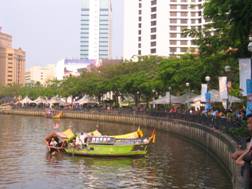
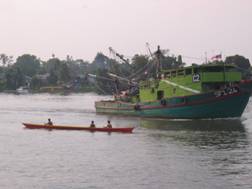


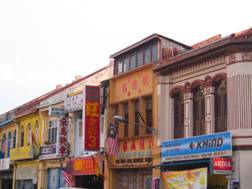


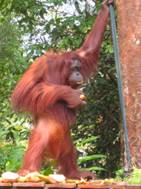


Kuching. A nice and relaxing river city, surrounded by national parks.

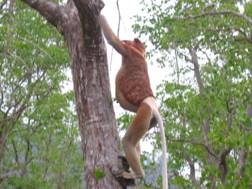
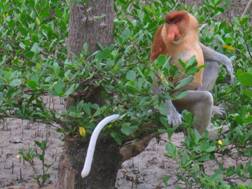
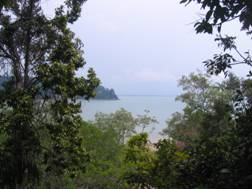


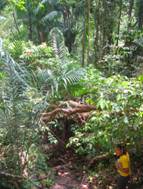

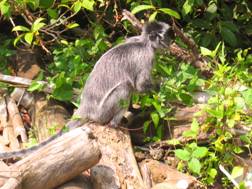


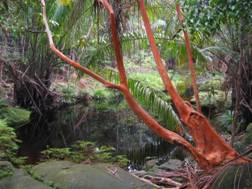

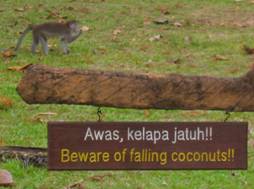
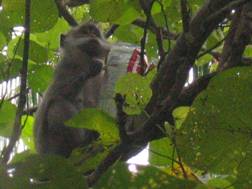
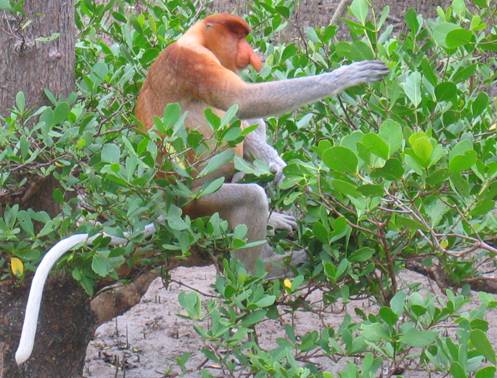
Bako National Park. One of the best parks I have ever seen because of the abundance of wild life: bearded swine, Langur monkeys, snakes, birds, and the rare and very beautiful proboscis monkey (neusaap). Because of its big red nose, in Malay language its offical name is "orang belanda" which means Dutchmen, thanks a lot for that folks!
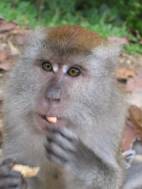
Allover Indonesia and Malaysia you also see heaps of macaque monkeys, and we were warned for the ones in Bako being very good snatchers. Nevertheless, the last picture shows a macaque high up in the trees with the second (!) pack of cookies he stole from us, ha ha.
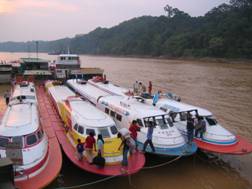

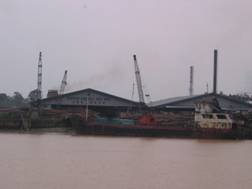

upriver towns. Lots of towns in Borneo can only be reached by boat or jeep. I visited the town of Kapit With a superfast passengerboat in the shape of a Boeing 747 plane without wings, they do over 50 km/h ! Along the river you can see the timber industry; outside the national parks all the jungle is being cut down rapidly. At some days there is a haze of smoke in the air from the burning of jungle in Kalimantan (Indonesian side of Borneo) to clear it for palm oil plantations. Some years from now, all of SE-Asia's jungle will be reduced to a few National Parks and a lot of palm oil trees.


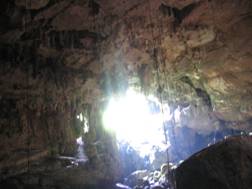

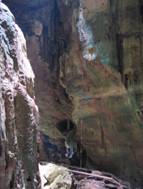
Niah caves. Inside one of the world's largest caves, lots of birds (swiftlets) are flying, and guys risk their lives to climb up to get their nest for the famous Chinese delicacy of bird's-nest soup.

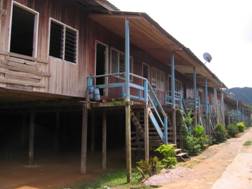
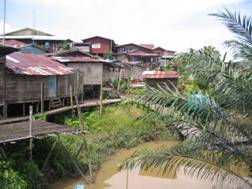
longhouses. Back in the old days, when most of the Dutch lived in brick farms, Borneo was famous for its tatood and pierced headhunters who lived in longhouses: a long row of stilt houses in which a whole village lived under one roof, to protect themselves from animals and other tribes. Nowadays however, Holland is filled with tatoos, piercings, headhunters and rows of attached houses, and most of the East-Malaysians live in nice houses, ha ha. The few remaining traditional longhouses are mainly for the tourists, but along the rivers you can still see some "modern" longhouses.
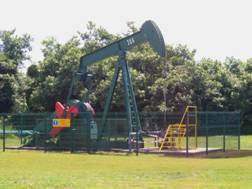
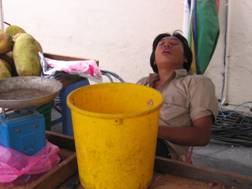
Brunei. The sultanate of Brunei is a tiny tiny country on Borneo, surrounded by East Malaysia, with only 350.000 people and a very very rich sultan. His fortune comes from oil and is estimated at about half a trillion US$ (=500.000 million). The people benefit from his whealth so don't they have to work very hard, see picture, ha ha. The country is so small that it actually owns a cattle station in Australia (for halal beef) which is larger than the sultanate itself.


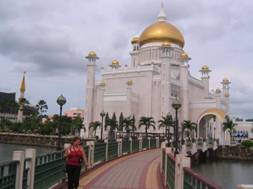

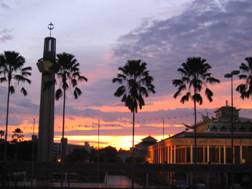
Mosque of 28th Sultan. The Masjid Omar 'Ali Saifuddien Mosque, paid by the sultan's daddy. Unfortunately it was not allowed to take foto's inside the mosque, where you can see an escalator (roltrap) for the royal family to descend onto the praying floor, hilarious!
Islam laws are very strict in Brunei, for instance a boy and a girl can not walk hand in hand in public (but the Sultan's brother's luxury boats are called "Nipples", "Tits 1" and "Tits 2").
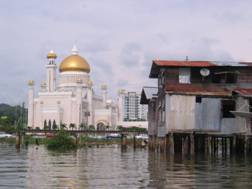
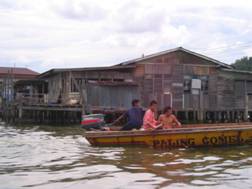
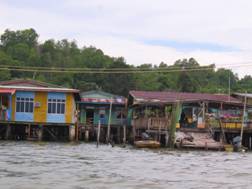

Kampung Ayer water village. A large part of the capital of Brunei consists of the water village, traditional stilt houses (paalwoningen), right beside the modern centre with mosques and high buildings. The water village looks very poor but the people just prefer to live in their traditional houses, everybody also has got a car (subsidised by the Sultan).
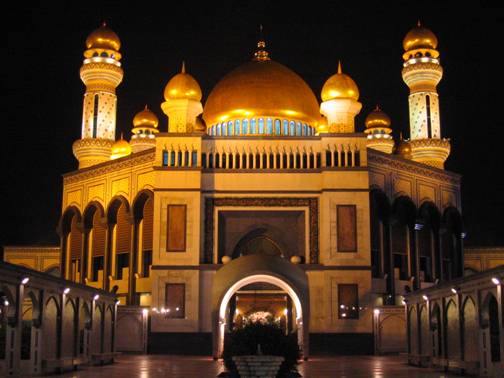

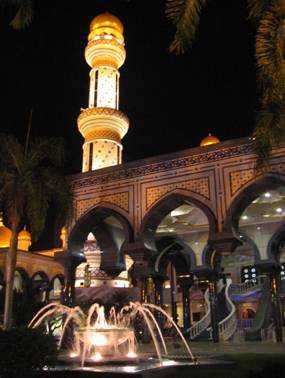
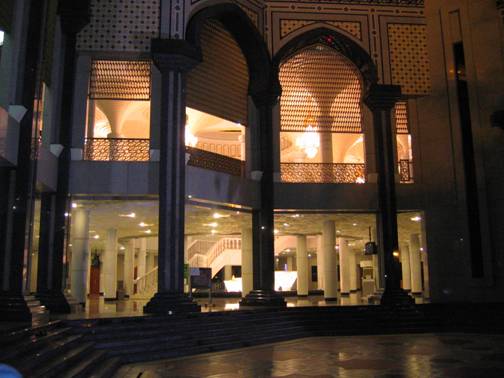


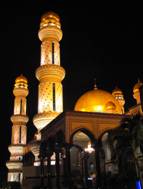
Mosque of 29th Sultan. Ten years ago the current sultan spent part of his fortune on a new (public) mosque which hurts both the eyes and the imagination: xx-carat golden domes, cristal candeliers, Italian marble, coloured fountains, and....yes, another escalator for the royal family (see 2nd picture). Forget about Rome, Jerusalem, Mekka or Taj Mahal; Brunei is the place to go to!

The sultan's palace. Dig this. The presidential palace is the biggest in the world with its 1170 rooms (200 bathrooms), for only 20 members of the royal family, the rest of the family have their own palaces. Next to the palace, the sultan has its own mosque (for 4000 people, you never know who's gonna show up for dinner), and near the palace is his fleet of air planes on his own airport. A few years ago the 59 year old sultan married his third wive (27 year old). But even the sultan has problems: his brother lost 16 billion dollar, so now the bad brother has to sell part of his collection of 600 ferrari's. Life's a bitch...
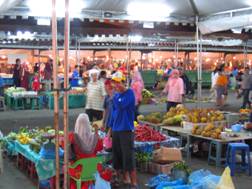
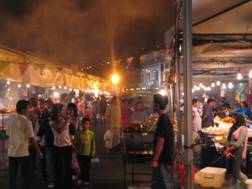


Brunei people. The Bruneians look like average Malaysians, but a little bit more friendly and relaxed (I would be too knowing that if you would divide the sultan's fortune between the Bruneians, everybody would be an instant millionair). The incredible Abdul showed us around Brunei, brought us back to Miri in Malaysia, and I even flew back with him to Kuala Lumpur.

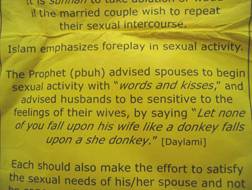

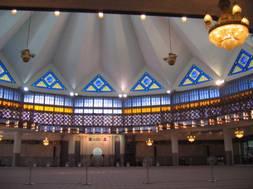


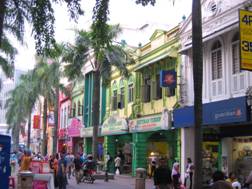
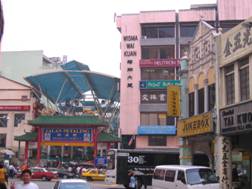
Back in KL. Back in Kuala Lumpur, I visited the national mosque in contemporary 60's architecture, and they gave me loads of brochures about the islam. While christianity basically sees all sexual activity as a sin, the Islam actually encourages sex as long as it is not extramarrital. My favorite quote of the Prophet is about foreplay: "Let none of you fall upon his wife like a donkey falls upon a she-donkey"...
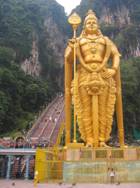
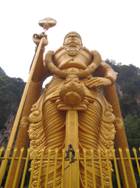


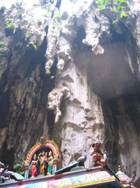
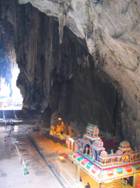
Batu caves. Near KL are the Batu caves with an impressive 40m high Hindu statue outside and some Hindu temples inside.

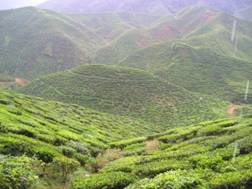
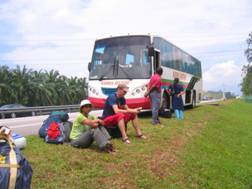
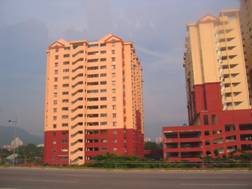
Cameron highlands. Up in the cool higlands are English style houses, tea plantations, and lots of rain. And a broken bus.




 <
<
Georgetown, Penang. The city of Georgetown on the isle of Penang is a former Britisch colony with lots of flats and a large and dirty chinatown: I've never seen so many rats and lady-boys before in my life, yakkie.
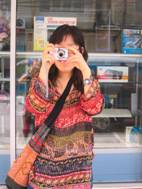
The last picture shows Mira from South Korea. She wil be travelling through 35 countries in 10 months and knows where she will be exactly on each day. When I thought this was amazing, she told me her Korean friends found here very spontaneous and disorganised, since they even plan alle the buses, hotels and restaurants for the whole year...
Aug 28,29: Melaka; 30, 31: Kuala Lumpur
Sep 1: Kuala Lumpur; 2,3: Kuching; 4: Bako NP; 5,6: Kuching; 7: Kapit; 8: Niah caves; 9: Miri; 10: Brunei; 11: Miri; 12, 13, 14: Kuala Lumpur; 15, 16: Cameron Highlands; 17, 18, 19: Georgetown (Pinang)


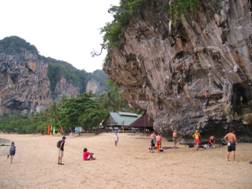

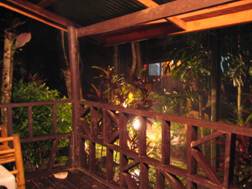
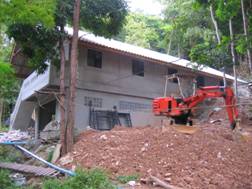

Krabi. Famous for its lime stone coastline with beautiful beaches and plenty of opportunity to sea kayak, rock climbing and even some dark moon partying.I stayed at the smallest and most quiet beach, Ao Tong Sai, but even this part is being developed like crazy: new concrete bungalows are built everywhere while the bamboo bungalows are falling apart.


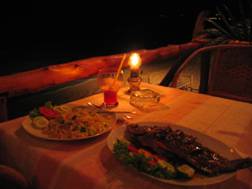


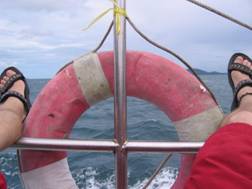
Koh Samui and monsoons. Nice but very touristy island.

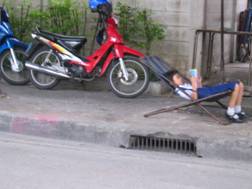
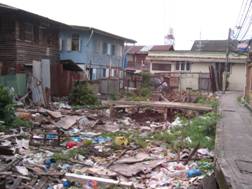


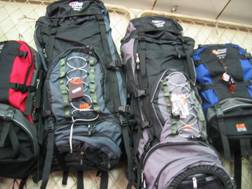

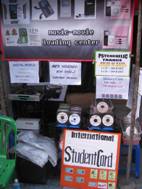


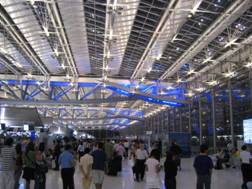

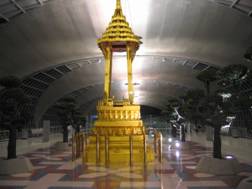
Bangkok. Great city, beautiful temples, funny people. Despite the recent "coupe d`etat", it is business as usual in Bangkok: you can buy some new and "very genuine" outdoor gear, cd's, international student cards (even if you are almost 40, ha ha), "genuine" designer clothes, and get your MP3 player filled with lots of new music. Unfortunately I couldn't stay very long in Thailand since this part of the year there are monsoons all over Thailand, so I rushed through Thailand to get to Bangkok and fly out of the country from the brand new airport. But I'll be back in a few months...
Sep 20-22: Krabi; 24, 25: Koh Samui; 26-29: Bangkok
Japan (Oct-Nov 2007)
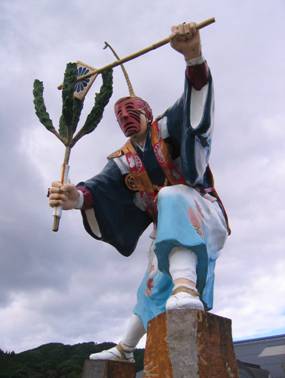
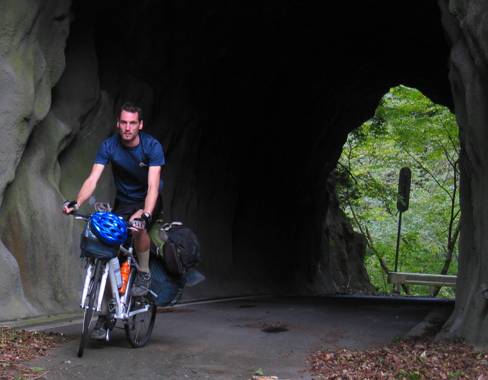
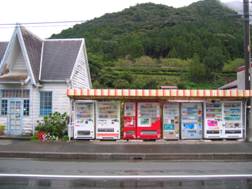


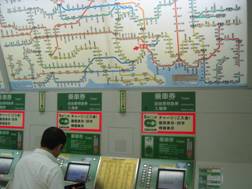
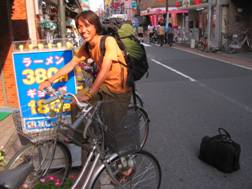
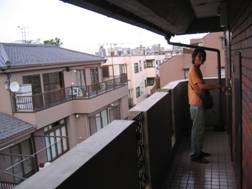

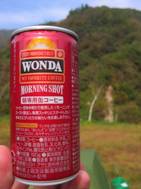
Tokyo. After I arrived with the plane in Japan on the airport of Tokyo, I was standing before a huge vending machine to buy a train ticket to the centre of Tokyo. In Japan everything is sold through vending machines, not only soda cans or train tickets but even hot coffee in cans and French fries, yak.
While I was studying the train ticket vending machine, a friendly Japanese guy named Yuki offered not only to help me with the ticket but we spent all day together, we went out with his friends and I could even stay at his appartment. What a nice and smooth introduction into Japan, thanks Yuki!
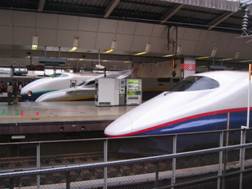
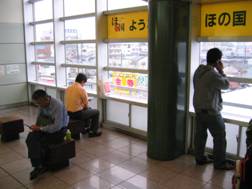

Meeting Keet: modern communication technologies. Keet is an old friend of mine who lived a few years in Japan with his family (Keetie and Kento) and for a business meeting he happened to be back in Tokyo again, so we were supposed to meet at the platform of the Shinkansen, the famous high speed bullet train. I travel without phone, so the night before I wanted to check my email for a message of Keet but there are not many internetcafes in Japan, so Yushi tried to log into my webmail with the internet on his mobile phone, but this failed. Instead, he sent a text message to a friend with my login and password, and this friend used his home PC to check my mailbox, and read out loud through the phone the contents of my mailbox (in Japanese-English, very funny), which told me that Keet was indeed coming to Tokyo. Brilliant, so far so good.
But Keet missed the train, and I was already in it, whoops, with over 200 km/h on my way to Toyohashi.
When I arrived in Toyohashi, I first try to sent an email to Yoshi, a friend of Keet. However the not English speaking tourist information desk told me that the closest internetcafe was a bus ride away so that was even more trouble. Hmmm. After having bought an international phone card I could phone Keet, but he was offline. Hmmm. Then I just asked a stranger to email Yoshi with his phone, but the stranger had a new phone and did not know how to use the internet. So he phoned a friend at home who had internet, failed to sent him a text message so eventually read out loud to him the message for Yoshi that I had written on a paper. Brilliant.
In the end, two people walked up to me in the station with a big smile, and they appeared to be friends of Keet who he had sent to pick me up after hearing my voicemail. So much for modern communication technologies.

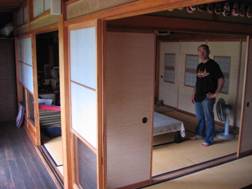
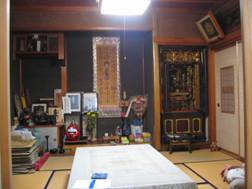

Yoshi. I stayed a few days with Yoshi, in his traditional home with sliding doors, floor mats and low tables, and a special room with a Shinto and Budhist shrine, Japans two main religions.
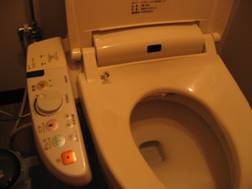
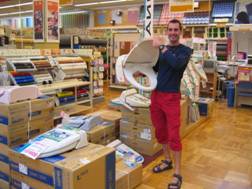
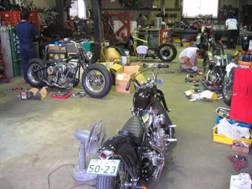
The house may be traditional but of course it had the famous Japanese high tech shower toilet! For my own disco toilet I would have loved to buy the most luxurious model with fart suction filter and with a remote control, so that I could turn on the sprayer from my living room while my guest is in the disco toilet getting a wet bum by surprise, ha ha, but the top model costed a fortune, so I chose a modest model which still has an impressive number of buttons. Yoshi not only helped me to buy and ship the shower toilet to Holland, he also took me sightseeing around Aichi: a.o we visited the world famous Zero engineering who customises Harleys. Yoshi, thanks for everything!

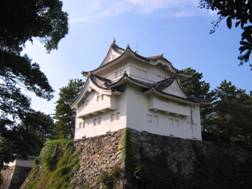
Nagoya castle. I had to be in Nagoya anyway to buy a bycicle, so I might as well visit the impressive castle.
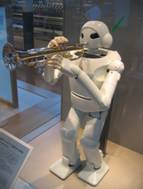

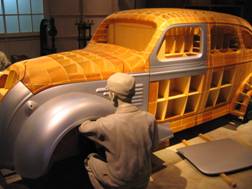
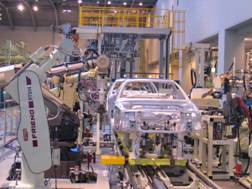
Japanese technology, Toyota museum. Japan is home to one of the best manufacturers of the world, not only very reliable but always the newest technology.
Canon for example is always leading in technology with digital cameras, e.g the new cameras with ISO 3200 and steady shot, one of wich I will probably have to buy soon since my old one is slowly dying. And I am sorry to say for my former Dutch colleagues, but Canon is also the best in copiers/printers concerning reliability and new features. However, one field Canon is losing is the semiconductor lithography, which is now dominated by Nikon and market leader, Dutch Philips offspring ASML.
Another Dutch company doing well is the former Van Doorne`s Transmissions, Keet`s company, whose Continuous Variable Transmission with a push belt is now applied in several Japanese cars.
Toyota, another example of superbe Japanese engineering, has been nr 1 in in car reliability for a long time, and is the first with its famous hybrid car Prius. Toyota city is near Nagoya, and I visited the Toyota museum, which explains perfectly how a car works and is manufactured.
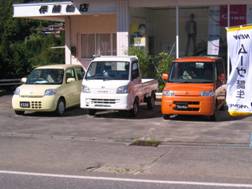

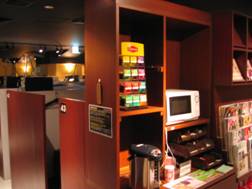
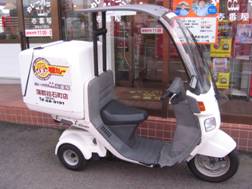


More Japanese technology. Everything is different in Japan, some examples (see pictures):
- Lots of little cars; probably the only country where men don`t mind driving a tiny car.
- Handy toilet sinks on top of the water reservoir who start.
- The combination of internetcafe`s and manga comics (to jerk off in your cubicle either digitally or on old-fashioned magazines).
- Lots of handy 3-wheeler mopeds and bicycles for deliveries and unstable riders.
- Gambling for money is prohibited, so they all play Pachinko, a ball game wich delivers litlle balls you can swap at the backdoor for money.
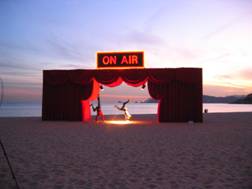
- A `fake` wedding chapel with a vertical parking garage.
- And lots more, every day I keep on seeing new things. Japan is fun.
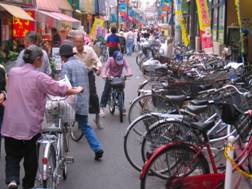

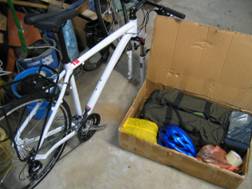
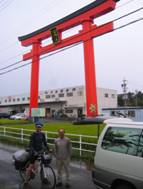
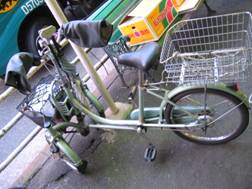
Buying a bycicle. Lots of Japanese bicycle in the city so the bike shops are packed with mamma bikes. However, mountain biking or racing is not very popular, so I had some trouble finding a (hybrid) bicycle, especially in my size. In Nagoya was a good shop, and not speaking English was no problem: they just phone a friend who does speak English, so we had on-line voice translation, ha ha.
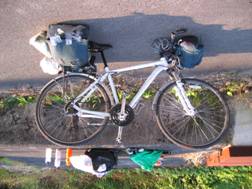
From Australia I had sent a parcel with my camping and bicycle stuff so I could finally saddle up my horse again. I haven`t touched a bicylce for 3 months so the beginning will be hard!
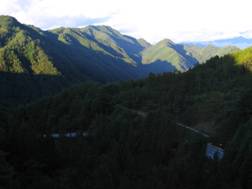
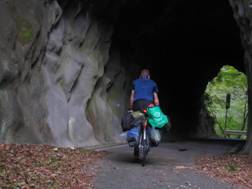


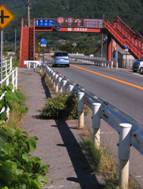
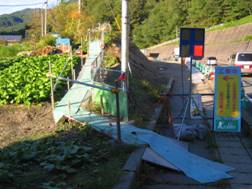
Biking in Japan. Japan and especially the Japanese Alps are not exactly bike friendly: steep mountains, long tunnels, narrow biking paths full of dirt and weed, which suddenly stop or wich are too small for my wide bacpack, and the bike paths often swap side so you have to go up over a bridge to cross the road.
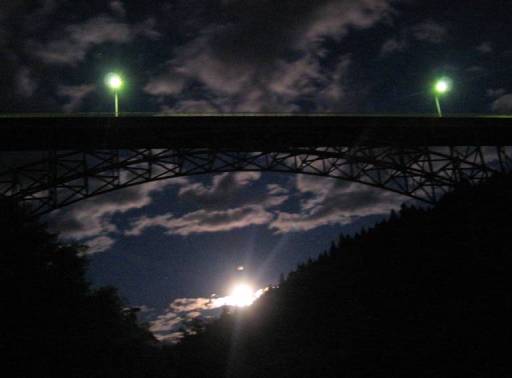


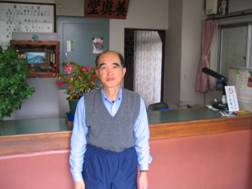
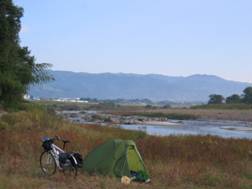
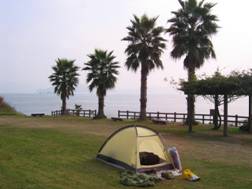
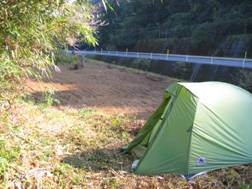
Accomodation. I have a Japanese road atlas of which I can only read the road numbers but not the town names, and I cannot get much help since almost nobody speaks English, so often I camp out in the wild. Once I found a camping, in stead of showers they had a bathhouse with an open air hot spring pool (Onsen) from which I could enjoy the full moon, very nice! Another time I ended up as the only guest in a youth hostel with a receptionist who had English cue cards like `have you forgotton anything`, very funny; the hostel did not have showers either but he gave me the entrance fee for the local bathhouse, where guys sit next to eachother in a row on little seats washing themselves with superhot water.
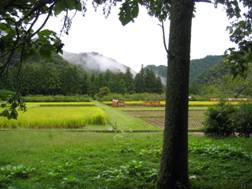
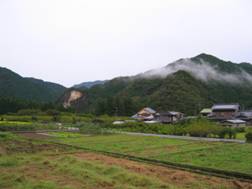
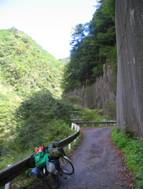

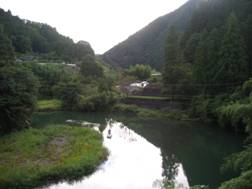
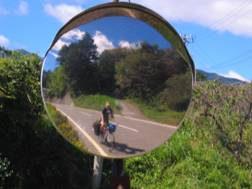


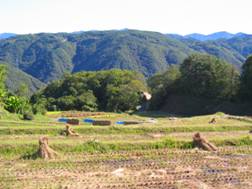
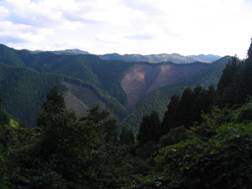
Japanese countryside. Most Japanese live at the coast so the countryside is remarkably empty and beautiful. The second day I was biking on a deserted mountain road and I saw a snake and two big hairy monkeys!
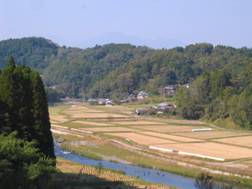
Agriculture is subsidised and looks very small scale: many small lots which are done by hand or with very simple machinery. The rice is hung on rows to dry.
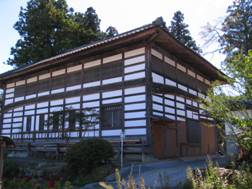

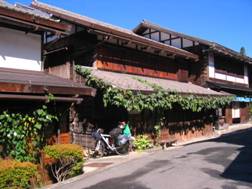
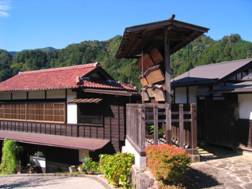
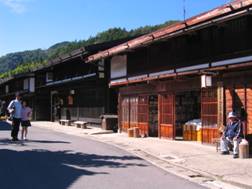
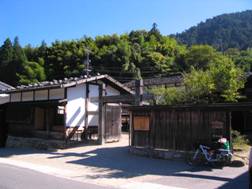

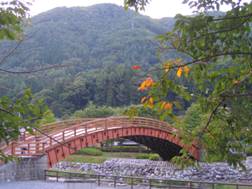
Magome, Tsumago, Narai.In the mountains are a number of preserved old posttowns with wooden houses like centuries ago, beautiful but very touristy.
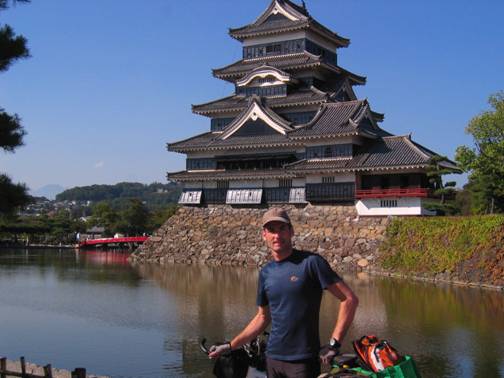
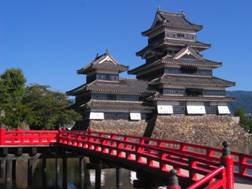

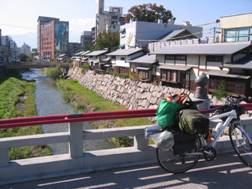
Matsumoto castle. Japans oldest and only wooden castle, around 1600. Compared to Europe, Japan has little old buildings left: many were made of wood and thus did not survive, some were destroyed during the second world war, and many were just replaced by new ones.
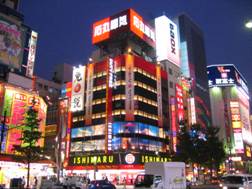

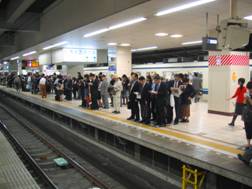


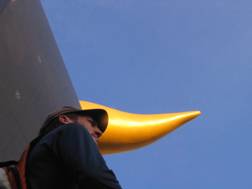
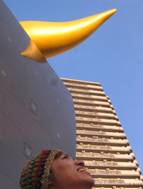
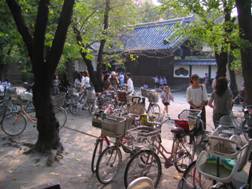
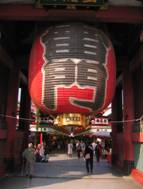


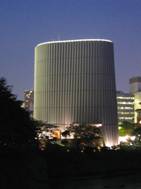
Tokyo. I parked my bike at the Matsumoto train station and went back for a few days to see Tokyo and Yuki again.

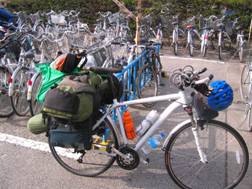
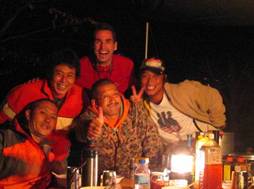

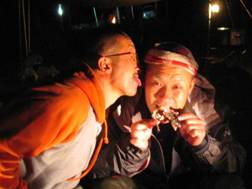
Back in the mountains, drunk. From Tokyo I took the train back to the mountains to cycle again. On the camping, some guys from Nagoya gave me lots of food and drinks.
Alcohol is a hard drug and since I never drink it, I am not used to it all. Refusing the offers would be impolite, and when the sake was gone there was a bottle of whiskey, and so on.
Each time I went to the toilet it was harder to find it to walk straight, and eventually the guys had to help me setting up my tent, which suddenly seemed a fun activity.
The next morning I woke up late with a strange feeling in my head, and I had to face the first serious mountan pass, hmm, bad timing, but...
Weer of gein weer, d`rop mit de beer.
Zin of geine zin, d`rin mit de pin.
Meug of neet meug, vlem `m op die zeug.
Laam of neet laam, zurg mer dat er schwaamp.
Zaat of neet zaat, duuj `m veur dat gaat.
Translation in Brabants: Nie mauwen.
Translation in Dutch: `s Avonds een vent, `s morgens een vent.
Translation in English: A man`s gotta do what a man`s gotta do.
So I put my lazy hangover ass on that 50 kg bicycle and made it over the first mountain pass. I will never drink again.
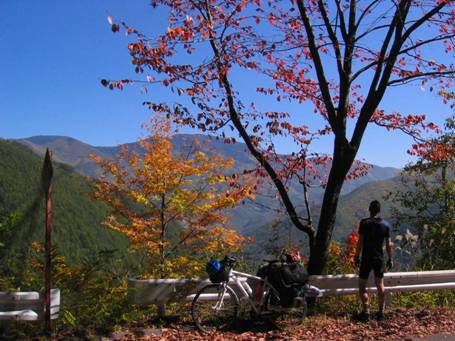


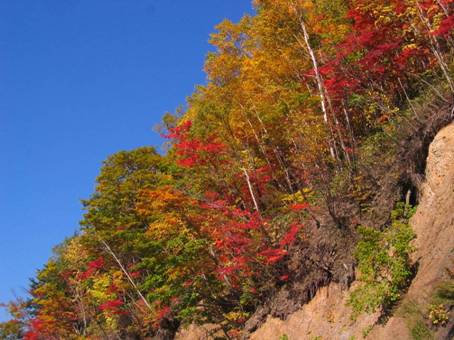

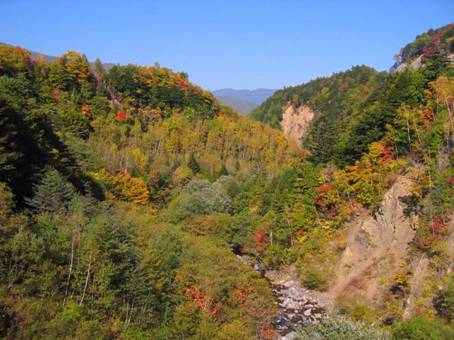
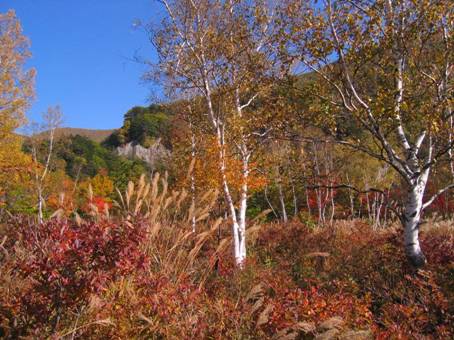
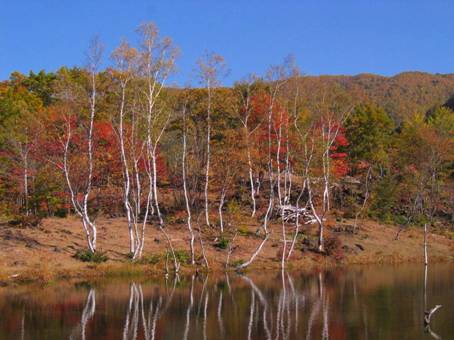
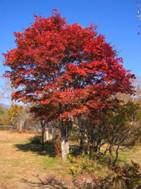


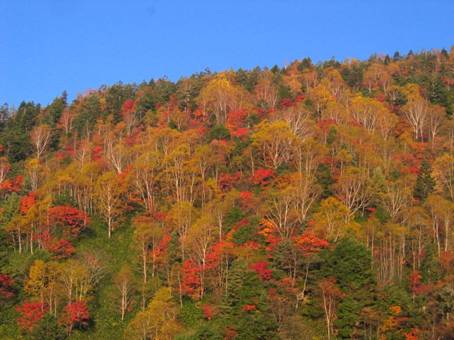
Autumn leaves. But it was worth it, the famous Japanese autumn leaves were even more beautiful than I thought, and lots of Japanese agreed.
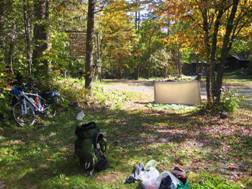
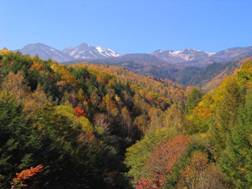


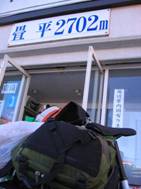
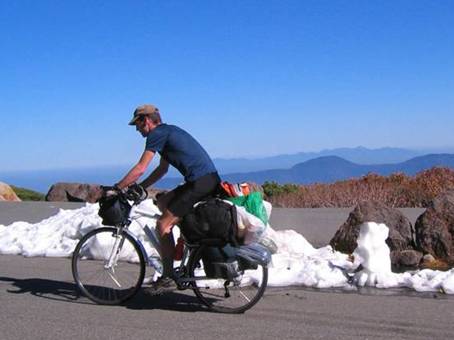
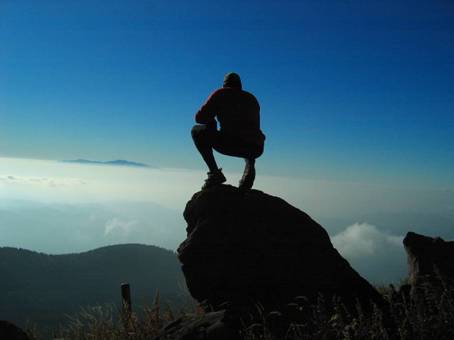

Dutchies over the top. Just before the top of a 2700 m high mountain pass, I saw two fully equiped bicyclists coming down, and of course they were ...Dutchies! They were already 17 months in the saddle and took the classic route from Europe through the middle east (Turky, Iran, Pakistan) to India, check out their website
www.travelbybike.ismijnpassie.nl.
On the top I walked into a `skihut` for a meal. Inside a guy was sitting in full winter gear with gloves and hat next to a stove to warm himself, and it was lots of fun to see his eyeballs pop out when he saw me in just my biking shorts and t-shirt. `What, you not cold?`. `Wat nou koud, tuurlik niet, watje, zeker nooit de oorlog meegemaakt, dat was pas koud!`
Yep, Dutchies rule...



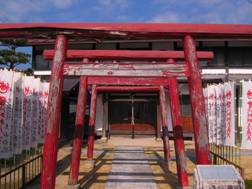


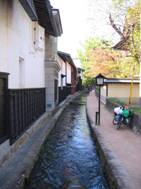

Takayama, Furukawa.These ancient villages are famous for their beautiful temples, canals and old houses.

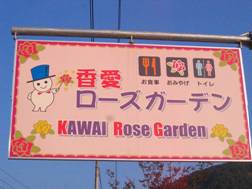



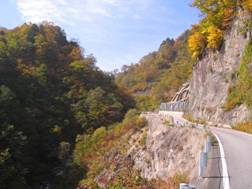

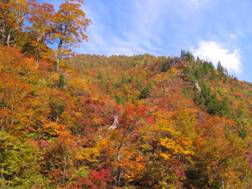

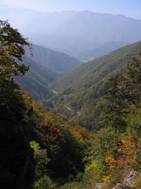
Kawai. `Kawaii` means cute in Japanese (and they sure love cute things), and `Kawai` is both a mountain district and...the name of a little cute boy in Amsterdam.


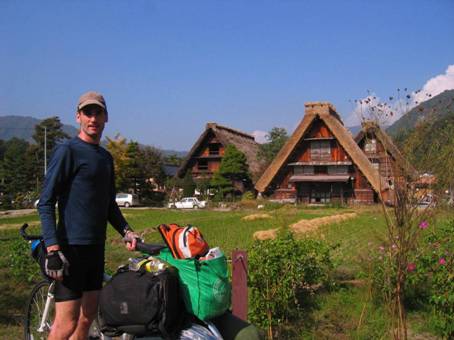
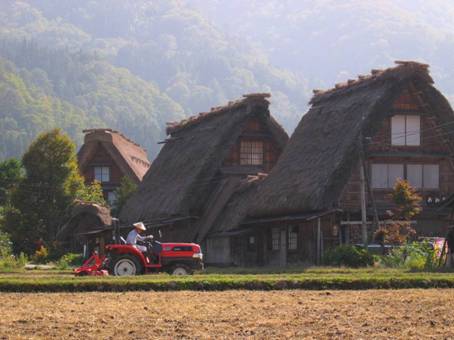
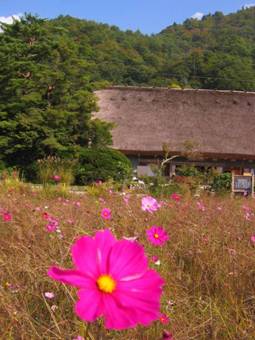
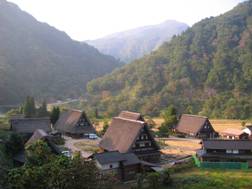
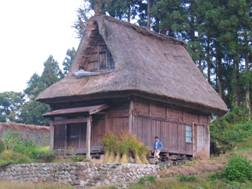

Thatched houses of Ogimachi, Suganuma & Ainokura. Vely toulisty but also vely vely beautiful.

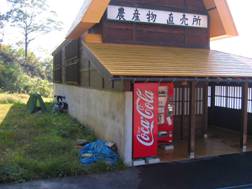

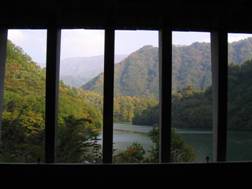
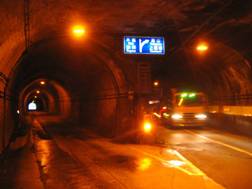
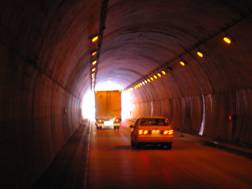
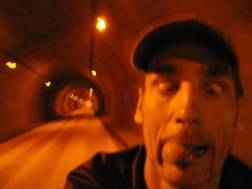
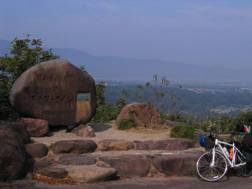
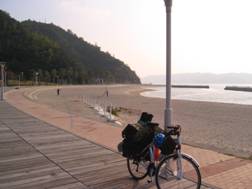
From the mountains to the coast . The last part of the Japanese Alps, in only a few weeks time they will be covered in snow and the high passes will be closed. The Alps were stunning but I was glad I was done with the tunnels when I reached the flatter coast.

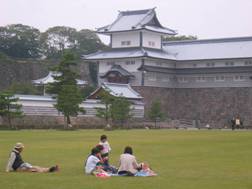
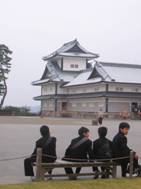

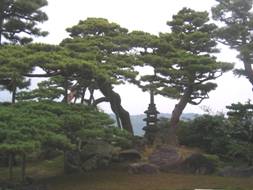
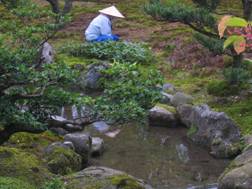

Kanazawa castle, garden and `ninja`temple. In Japan you have to take your shoes off in every house. When you visit a castle, you carry your shoes in a bag with you, but I don`t know if it is realy beneficial for the preservation of the castle if I run around barefoot; aT least ik keeps the rats away, ha ha.
The last picture shows the Kanazawa `ninja`temple, unfortunately it was not allowed to make any pictures inside this funny temple with lots of secrets floors, stairs, doors, traps, hideouts etc. to surprise and confuse the intruding enemy. If all these tricks didn`t work, there was a special little room with a one way door, in which the defeated commander had to commit harakiri...


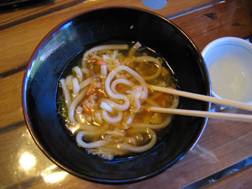
Finding food. This is not an easy job. First you have to find a restaurant, but they can be hard to recognize as such. Second, you have to pick something from the menu, not easy if this is just a row of wooden planks with characters. So I often go for the surprise menu (point at a random menu item hoping it is not just tea) but this sometimes freaks out the waiter, ha ha. It doesn`t matter because it is always noodles anyway.

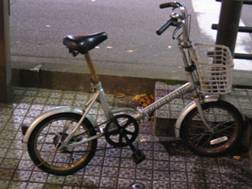
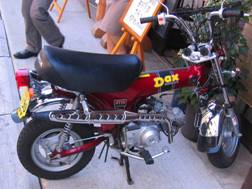


Mini. Sometimes you find a restaurant with pictures or even some English. You grab the opportunity to eat something else than noodles, yes! What a disappointment when even Western style food is Japanised: the portions are very modest. This is why Japanese are all so slim and live so long: they eat hardly any fat or sugar (try find a bottle of Fanta, my favorite biking fuel), and they eat small portions. Everything seems to be small in Japan: not only the hamburgers but also the bicycles, mopeds, motorcycles, cars, trucks and roads.


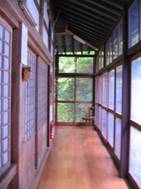
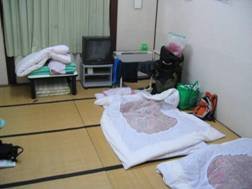
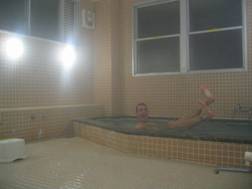
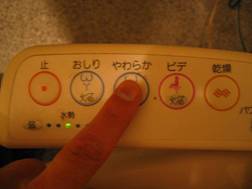
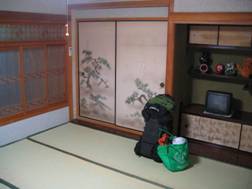
Japanese youth hostels. Some are very traditional: sliding doors, floor mats, futons, common bathrooms. But of course very modern toilet seats, ha ha.

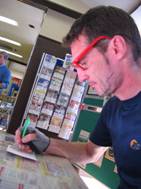


Public services. Japan is not always as neat as you might think (1st picture). And honest neither, Japan has its own version of white collar crime, the Japanese mafia is called yakuza. But the streets are very safe, petty crime levels are very low, such as common theft, and thus some public services are excellent: reading glasses in the post office, free internet in the city hall, very clean public toilets with... heated seats.

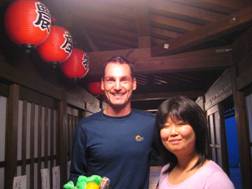
Japanese kindness. Looking at too many Japanese movies about samurai, yakuza or tea ceremonies, you might get the false impression that the Japanese are very quiet and serious people. They can be shy sometimes, but generally they like a good laugh as well as we do, they are very interested in foreigners so often come over for a chat, and they are extremely friendly and helpfull.
Besides Yuki and Yoshi, here are some other examples of Japanese kindness:
- A guy in a restaurant helps me with the menu and when I want to leave the restaurant a while after him, it appears he had already paid my lunch.
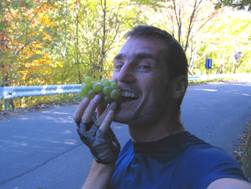
- (1st picture) I`m going up the mountain, a car somes down and stops, hands me over some grapes, and is gone again.
- (2nd picture) When I ask someone about a supposedly nearby camping, he completey converts his car to throw in my complete bike, and drives me to a tourist information (who don`t speak English either, but anyway).
- (3rd picture) At dawn, I was washing myself in one of those very clean and luxurious public toilets, and I hear women`s shoes coming down the hallway and a knock on the men`s door.
Damn, I am practically naked and this must be some officer going to tell me I can`t camp here. I put on some clothes and slide the door open, and there is a girl offering me a little bag with fruits and a bun. Just because I`m a tourist. Her mum took a picture of us, and they took if in their car.
An hour later, I was reading in my tent, and there was some noise outside: they came back with a gift box of cookies, and to warn me for the Japanese bears that sometimes came down from the woods. Unbelievable.
But sometimes the Japanese can be real Japanese, ha ha, check out his sneak movie I made.
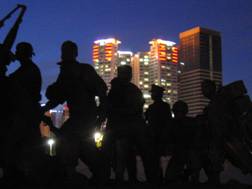
Mind you, this is not a militairy training to prepare for the coming nuclear attack of North-Korea, this is a regular training of gas station attendants:
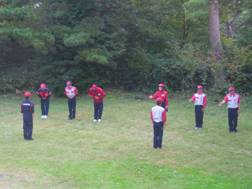
6 MB MOVIE: japan training.avi
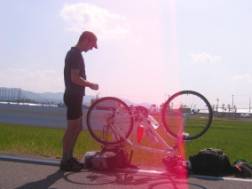

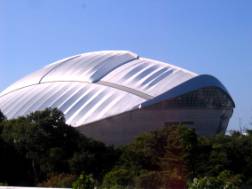


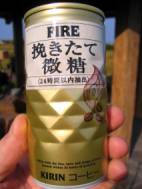
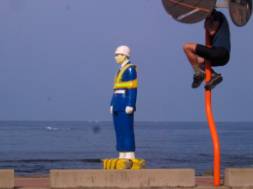


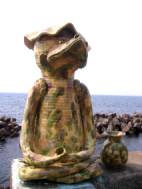
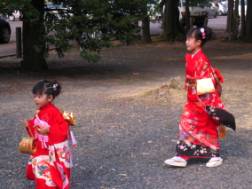


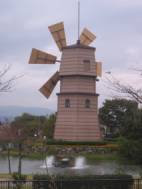
Along the coast. I turned back south again to complete the circle through the Alps, but chose the quick way along the coast.

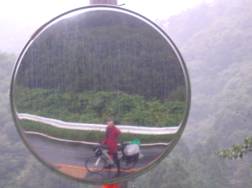
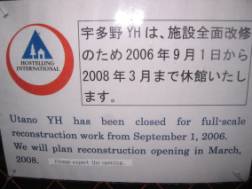

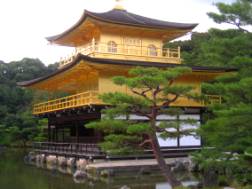


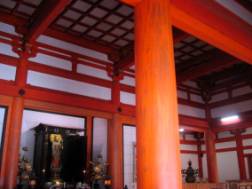


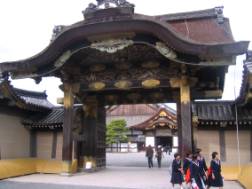
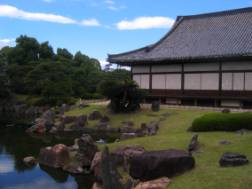
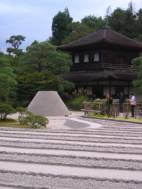



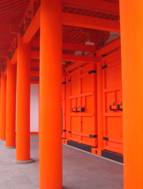

Kyoto. The welcoming in Kyoto could have been better: I first biked 60 km through the pooring rain to get to Kyoto, and then I had to bike an additional 60 km inside the city to find a hostel: the 1st was in reconstruction, the 2nd was just closed, the 3rd had no receptionist, the 4rd was completely chartered, the fifth was full, etd. Ridiculous, there must be something wrong with Japanese capitalism if they don`t start more hostels in Kyoto. Anyway: Kyoto, former capital of Japan, a rather ugly city with a lot of beautiful temples, shrines and palaces. Highlights were the golden pavillion and the temple with 1001 gilded statues. Lowlight was one of the famous Zen gardens: it is a rather silly sight to see hundred tourists staring for ages at a few rocks amidst nicely raked gravel.


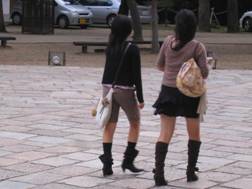

Food, testosteron, old people and good deeds.
The recipe for a long and healthy life is:
1. Eat little but varied (lots of vegetables and fruits, little red meat).
2. Exercise (walk or bike to work or shop).
3. Take fresh air (ventilate at your work and home).
4. No drugs (alcohol, tobacco or other stuff).
5. No stress (take a holiday, get married, believe in god).
6. Guys only: moderate sex (sex boosts your testosteron, which drastically shortens your live. Your testosteron level is above average when your 3rd finger (ringvinger) is longer than your 1st finger (wijsvinger); no joke, scientifically proven.
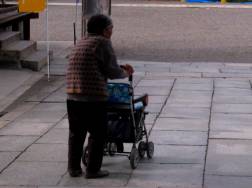
Japanese do pretty good at this checklist, they all seem slim and pretty distressed. Allthough McDrek and other sweet&fat chainies are widespread in Japan, most Japanese still eat their traditional dishes of rice, noodles, seeweed, and fish, so not a lot of fat or sugar or red meat. This is one of the reasons why you hardly see any fat people in Japan and why they all get so old. There is a lot of very old people walking on the streets, guys with sticks and women with little shopping or baby carts.
My good deed for 2006: When I was standing in Kyoto on the probably wrong spot to cross a huge and busy 3-lane street crossing, a very old lady next to me tried to say something to me, but I told her I didn`t speak Japanese. When I tried my luck to cross the busy traffic and looked back at her, she put one foot on the ashfalt but held on to the railing, she was to afraid for the traffic. So I went back to pick up the poor old thing and cross together, however she appeared to be half blind as well and started walking diagonally into the center of the street crossing, and I had to grab her repeatedly to put her back on the right track, while lots of Japanese eyes where looking at this funny scene of the tall foreign biker pulling a tiny Japanese granny, ha ha.
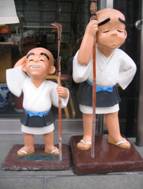



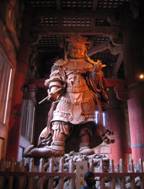

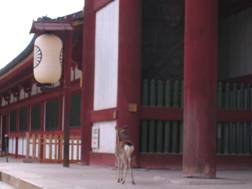
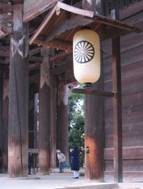


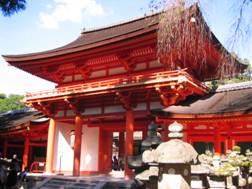
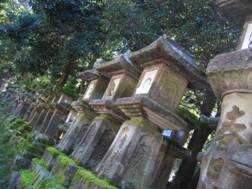
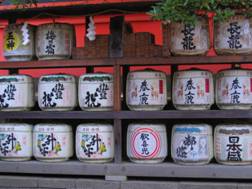
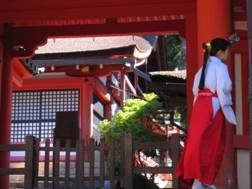
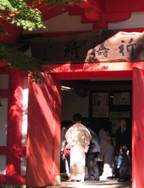


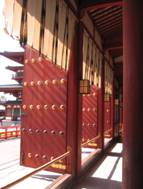

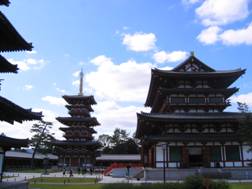
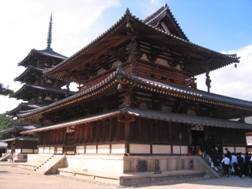
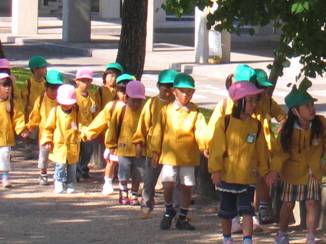
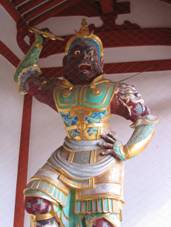
Nara. Another former capital of Japan, with another impressive collection of temples, a.o. one with a 15 meter high bronze Buddha statue.


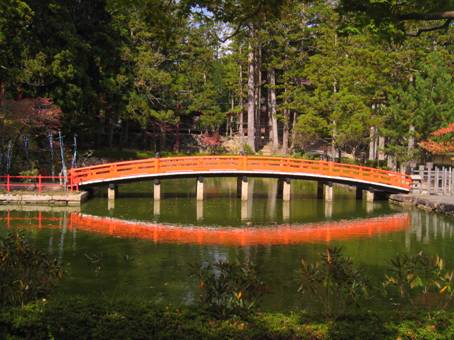


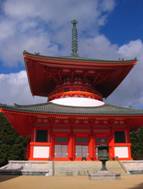

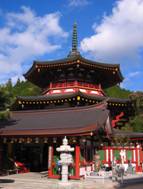
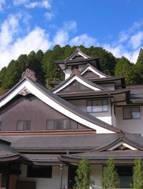

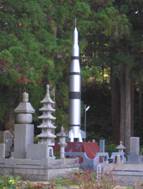
Koya-San. On top of mount Koya is a buddhist village up with... another impressive collection of temples, and a huge cemetery.





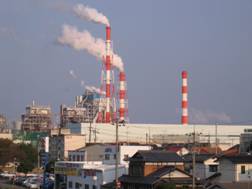
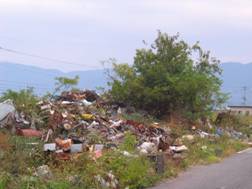
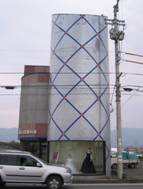
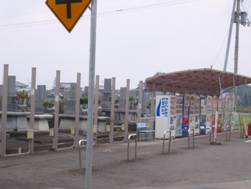
Ugly and dirty Japan. Leaving the main island of Honshu with the ferry to the (3th largest) island of Shikoku, I got a taste of the other Jpan, the ugly and dirty.
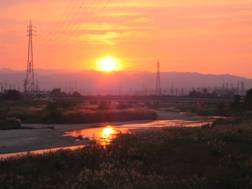
The Netherlands almost have the world`s highest population density, and the Dutchies live in a lot of rather condensed cities and villages more or less evenly spread across the country, and inbetween is farmland and a little bit (5%) of forest. Japan also has a high population density, and this is even fortified by the fact that 75% of Japan are forested mountains (very beautiful); the remaining 25% is for the cities, villages, industry and farmland, and is very very ugly, in fact it is the ugliest landscape I have ever seen:
- Everywhere are power lines and overhead cables.
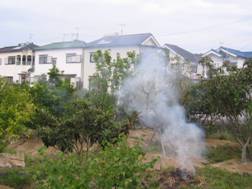
- Polluted air: smelly factories, fires everywhere from farmers burning hay.
- Urban sprawl: even in Tokyo most people live in a house and not in an appartment, but it is condensed enough to support public transport. Outside the big cities however, the towns sprawl all over and (like Los Angeles) create an neverending sea of roads, houses, cars and shops with big road signs, without any real countryside or a town center.
- Everything is situated completely random through eachother: houses, factories, farmland. The last picture shows a parking lot with soda vending machines right in front of a cemetery...

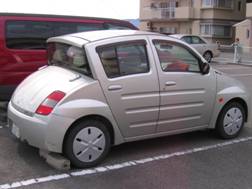

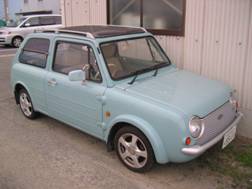
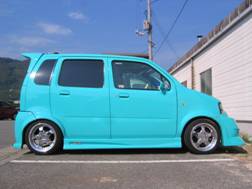
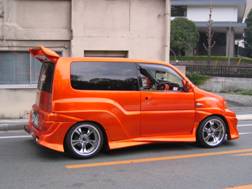


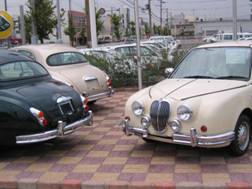


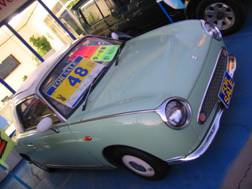


More ugly Japan. Some Japanese designs are quite funny and especially cute (first pictures), and `de gustibus non disputandum est` , but most Japanese designs just sucks, or is a bad copy of former European classic car designs.
Check out these bad imitations of the Jaguar MKII, the Mini, the Beatle and the Kharman Ghia. Furthermore, most modern houses look prefabed and very ugly. The last three pictures show a ferry with fake masts, a modern windmill and last but not least: along the Inland Sea I saw many (empty) recreational beaches right next to big shipyards en harbours.
This everpresent ugliness seems very strange to me for a country with a love for Zen esthetics like tea ceremonies, flower arrangement and gardens.


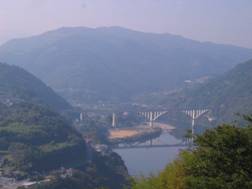




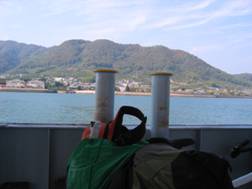

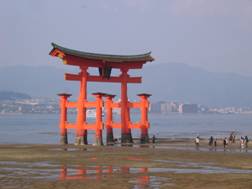
From Shikoku island acros Inland Sea back to Honshu island. Most of the giant aerial driveways (ramps) in the pictures are only for bicycles, incredible.


Hiroshima. I did not like Hiroshima, not so much because it is just another ugly Japanese city but more since the A-bomb museum shows a rather biased picture of the war: it kind of tries to victimize the Japanese and does not tell anything about who started the war and whatfor, so it is not exactly a contribution to world peace and education, as it claims to be. Therefor I shall try to explain things better for the Japanese kids here, he he:
At the end of the 19th century, Japan tried to expand its territory into China but was not very successful. In the mean time, the state shinto religion made lots of Japanese think that they were superior to other Asian people and that their emperor was even divine. The country industrialised quickly, the military took over the government, and they started a new war in China in 1937, and when they raided the capital of Nanking they massacred about 200.000 Chinese, most civilians.
At the other end of the world something similar happened. The Germans were pretty frustrated about losing WWI, and some Austrian corporal was even more frustrated because a goat once took one of his balls and his grandmother was Jewish. He was so pissed of that he tried a coupe d`etat (Putsch) in 1923, shot a hole in the cellar ceiling of the Muenchner Hauptbrauhaus, got jailed for it, but then years later he managed to succeed. Same story: quick industrialisation, military take over, and lots of people adored the corporal who was now prime minister, and they all thought they were a better race than their neighbours. They even blamed the Jews for everything and tried to kill nearly all 5 millions during their invasion of Europe.
While Holland and France and Britain were very busy with the Germans, the Japanese took over their colonies (Dutch Indonesia, French Indochina, British Malaysia, etc.), enslaving and killing and raping them.
In the mean time, the Germans made a big mistake: they tried to invade Russia, just ask Napoleon how stupid this is, so the Russians fought back, losing up to 20 million people (!), and eventually freed Berlin.
The Japanese were also stupid and tried to fight the other giant, the USA, but the Yankees of course won the Pacific War.
End of the story? Not quite, because the Japanese wanted to fight till the bitter end: the Yankees asked for unconditional surrender but Japan refused, the military announced to make Japan a country of 100 million honourful dead. This brings us to the final blow:
In 1938 German scientists discovered the immense power of atomic reactions. German Jewish scientists who fled to the states pushed Einstein to write a letter to preseident Roosevelt to start developing an atom bomb before the Germans did. In june 1942 Rossevelt approved, and the Manhattan project was born, including all big scientists like Feinman, Fermi, Bohr, etc. Half a year later, Fermi had the first chain reaction going, and two years and 2 billion dollars later, on Jun 16th 1945, the Yankees tried their first atomic bomb.
One month later they went to Japan with a uranium bomb called `Little boy`, had it exploded on August 6th 1945 at 500 m above Hiroshima city, and bang: 70.000 people were killed instantaneously by the heat and the blow, another 70.000 died the following year because of their burns, other wounds, and radiation sickness.
Sounds dramatic, but more people were killed in Tokyo in one night of old-fashioned bombing by the allies. So let`s not get sentimental, I once payed a visit to Oswiecim (Auschwitz) in Poland were the Nazi`s had 2 million innocent jews go up in smoke, that is a lot more impressive than a Japanese city full of soldiers and civilians who started the war. Nevertheless, Hiroshima is very important as a symbol of the nuclear arms race that is still going on. Allthough no one has ever deared to nuke again, it has been considered to use on many occasions and you never know what countries like Israel, Pakistan, India or North-Korea are going to do with their nuclear warheads.
Fortunately for us Europeans the cold war is over, because we have been considered the nuclear battlefield of the two giants...
Conclusion: I found the museum in Hiroshima very inappropriate: it doesn`t suite to victimize yourself in this way and to not teach kids the truth, especially when you have started the f**king war. I suggest you start apologizing to the Chinese and other victims first! This is what we Dutchies should do too to the Indonesian people for our own colonial wars.
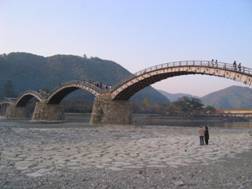

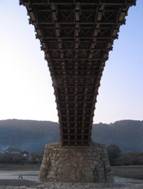
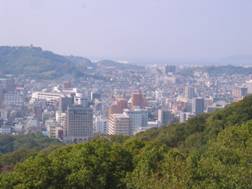


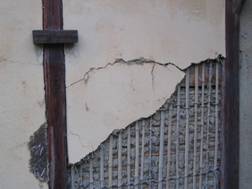


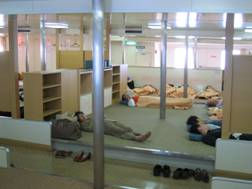
Via Iwakuni back to Shikoku again: Matsuyama, Uchiko, Ozu, Uwajima.





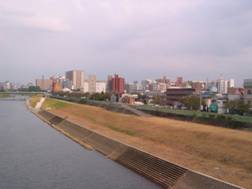
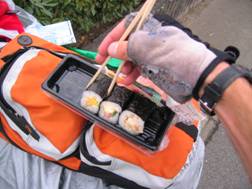

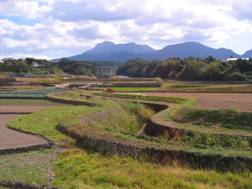

Across central Kyushu island.

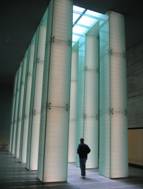

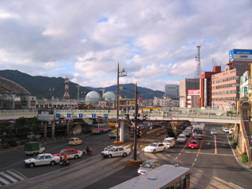

Nagasaki A-bomb museum. Three days after the A-bomb on Hiroshima, the Yankees nuked Nagasaki, this time with a plutonium bom called `Fat Man`. Allthough a lot heavier bomb, the number of casualties were about the same as in Hiroshima because the Nagasaki hills took part of the blow. Even a few Dutch POW`s got killed this time.
Now the military had little choice but to surrender. The emperor had to leave his heavenly throne, and his voice was broadcasted for the first time across Japan saying that `the war had developed not necessarily to Japan`s advantage`. Ha ha, the greatest euphemism ever, meaning of course `we have lost the war`.
The rest is history: some soldiers committed suicide, a few ones on little islands didn`t surrender up to the 1970`s, but the rest of Japan was glad the war was over, and the Yankees put in the new Japanese constitution that the Japanese army may only take up defensive tasks.
The Nagasaki A-bomb museum is a lot better than the Hiroshima one and more informative, but still very biased, no pictures about the evil things Japan has done to its neighbours.
I do not want to offend any Japanese, but I think that one of the reasons why they started the war is because the Japanese still are (just like Germans still are) very conservative and obedient to authorities. You can build as many peace memorials as you like, but you`d better teach the kids what really happened during the war, why people start wars, that we are all capable of evil. Germany does a better job in this than Japan I`m afraid...
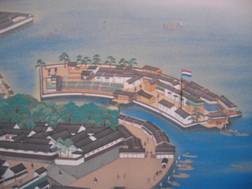


Nagasaki historic Dutch trade settlement. In the 16th century, the Portugese were the first Europeans to visit Japan and start trading. They also introduced christianity which so popular that it was seen as a threat by the Japanese government (very smart!), so finally they banned it and kicked out the Portugese. However, the Dutchies in those days already had freedom of religion (we still don`t care as long as you behave and pay your bills, ha ha), so we were allowed to stay, together with some Chinese traders. Japan was integrateed in the Asian trading network of the Dutch VOC, the first multinational company. For the folowing two hundred years, the Dutchies had the monopoly of trade with Japan, and we were they only link to Europe, not only for trade but also for news, science, medicine etc, until Japan opened up again in the 1860`s.

Japan tips.
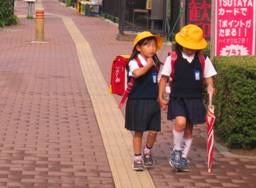
- don`t worry about anything, because Japan is the safest place on earth: little kids walk around everywhere, bicycle locks are a joke, and there is lots of US tourists.
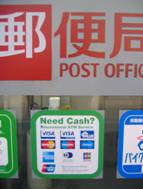
- about the only place where your bank card works are the ATM`s in the post offices.
- almost nobody speaks English but Japanese are very helpful. Besides gestures, there is a lot of tricks to bypass the language problem: writing something down in English or pictures helps, phoning an English speaking friend, memorizing the buttons of software, bringing an old picture of yourself to the barber, etc.
Sep 30: Tokyo
Oct 1,5: Aichimito (,Nagoya, Toyohashi); 6: Hamamatsu: 7: Anan; 8: Magome; 9: Narai; 10: Matsumoto; 11-13: Tokyo; 14: near Kamikochi; 15: Norikurakogen; 16: Takayama; 17: Kawai; 18: Ainokura; 19,20: Kanazawa; 21: Fukui; 22: Otsushi; 23,24: Kyoto; 25: Nara; 26: Koya-San; 27: Wakayama; 28: Tokushima; 29: Ikeda; 30: Matsuyama; 31: Onomichi
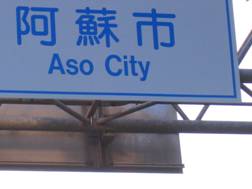
Nov 1: Hiroshima; 2: Matsuyama; 3: Ozu; 4: Unyu; 5: Aso; 6: Shimabara; 7,8,9: Nagasaki; 10: Huis Ten Bosch; 11,12: Fukuoka



A promising start. My first days in Korea were promising and fun:
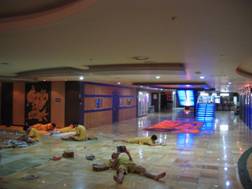
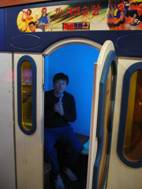
The gym (1st picture) Rodge ended up on the floor of a mental institute? Nope. Jail? Nope. Don't ask we how I got there, but on my first evening in Korea in the big city of Busan, I ended up in the busy centre on the 9th floor of a big building, coming out of the eleveator with my full packed bicycle, into a ...gym ? Huh? It was a surprise as much for me as for the receptionist, ha ha. Half an hour later I had taken a shower and was lying in a "suit" on the typical Korean heated tile floor among Koreans. They don't have any problems sleeping on the rock hard floor with just a blanket, but I almost broke my back and hardly slept at all. Very interesting, but never again.
The supermarket (2nd picture): The Koreans had beef, Fanta, yoghurt and lot of other (especially sweet and fat things) I had missed for so long in Japan.
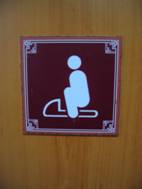
The reversed squat toilet (3rd picture): In Japan there were lots of squat toilets and I often found them inconvenient. It wasn't until I saw the reversed Korean squat toilets together with this symbol, that I suddenly realised that I had been shitting in reversed direction all the time in Japan, ha ha.
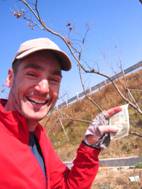
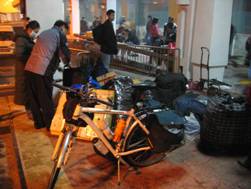
The donation (4th picture): Biking on the highway, a car stops next to me, shouts 'MTV' at me while sticking up his thumb, hands me a note of 10 thousand Won (about 10 Euro), and drives on. Thanks!
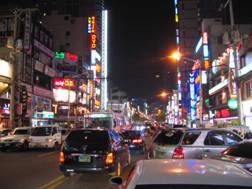
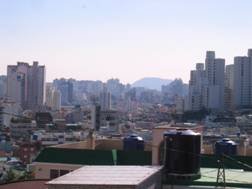

Busan city. Korea lies geographically in between Japan and China, and you could say the same for the people and their culture. Coming form the quiet and polite Japan, it is suddenly a shock to be in the agressive Korean traffic and hear all the horns.


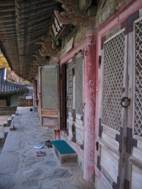
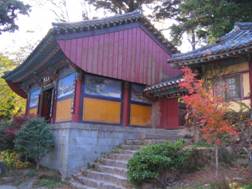

Beomeosa temple.


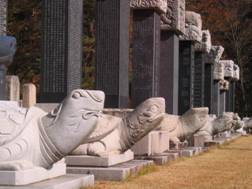


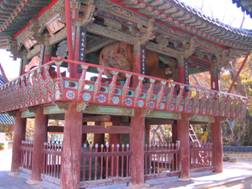

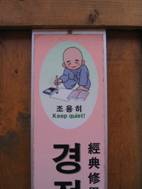
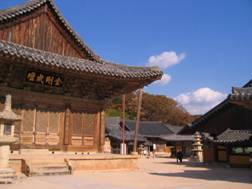


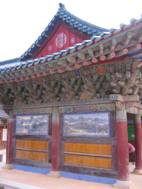
Tongdosa temple.
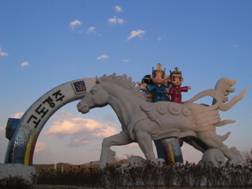



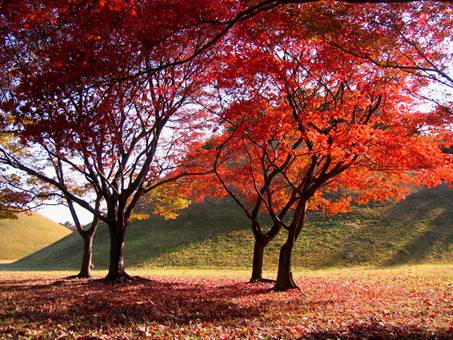

Gyeongju city. Former capital with loads of temples and royalties buried under little hills.
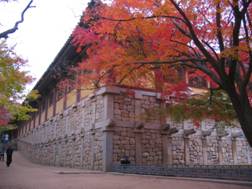


Bulguksa temple.


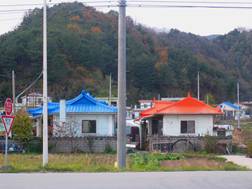

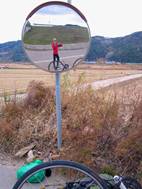
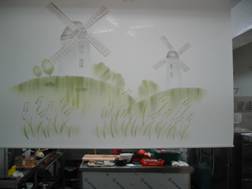
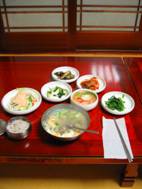

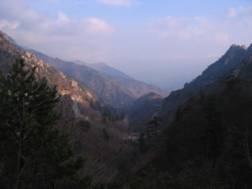
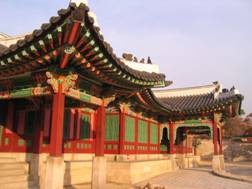
From south to north. The Korean landscape is not exactly pretty, sometimes the appartment buildings remind me of Eastern Europe. Even the supposedly most beautiful national park of Seoraksan was not exactly that pretty with all that concrete around.





Seoul. Its 10 million people makes it one of the largest cities in the world.
Korean war museum. Korea is the Germany of Asia: since the 2nd world war it is split in a communistic north and a capitalistic south, despite the 1950 Korean war when the communistic north tried to take over the south, and the UN troops (including Dutchies) had to help the south and the Chinese the north.

In the mean time back home....
Nov 13: Busan; 14: Tongdosa, 15-18: Gyeongju; 19: Gangneung; 20-23: Seoul
China 1 (Nov-Dec 2007)

China. Apart from the food, my first real contact with China was at my former company Oce.
I had already quite some experience with project leaders who were not exactly brilliant and try to compensate this by being extra rude and unreliable, but they seemed innocent pussy angels compared to my last projectleader, the Chinese. He was probably the most rude and dishonest guy I have ever met in my life, and it was not because his Dutch was understandable, ha ha. I always thought it was his Machiavellistic character caused by a childhood trauma or maybe he tried to compensate for his height, but since I have been in China, I must confess I made a terrible mistake: he was just being an average Chinese, they are just like that! On hindsight, he was even very civilised for a Chinese. Allthough he did yell a lot and was sneaky and rude, he didn't clear his throat in public, he didn't spit on the floor, he didn't try to rip me off for lunch, he didn't try to jump in front of me in the queue, and he put all trash in the bin.
Therefor, my apologies to one of the most civiised Chinese I ever met: mea culpa, mea culpa, mea maxima culpa.
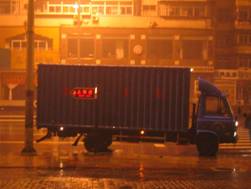

Tianjin. My arrival in China was memorable. It was raining cats and dogs, I did not have any Chinese money, and no taxi wanted to put my bicycle in his trunk. But they did call a "colleague" whi appeared to have a truck, ha ha, whith which I arrived at the hotel where my Peruvian friends helped me out.


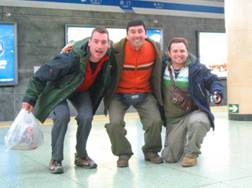
Beijing, the Peruvian days. In Beijing I met the Peruvians again and we spent a couple of crazy days figuring out a way to get them to Korea and through Korean customs, while their visa, money and marriages were almost running out. Too long story, all you need to remember that latino's are very impulsive and therefor fun people but disastrous planners.

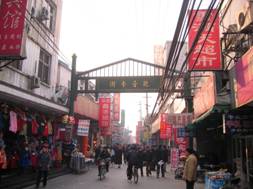

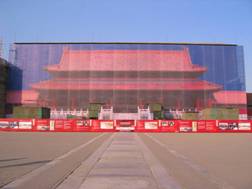
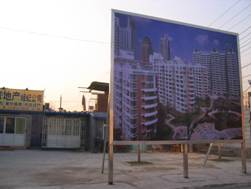


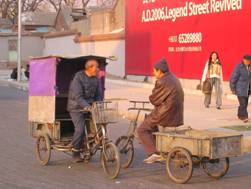
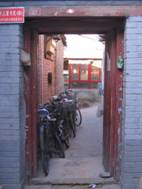
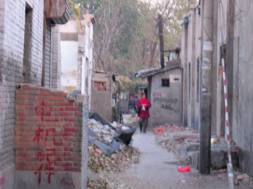
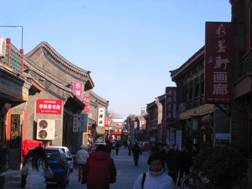

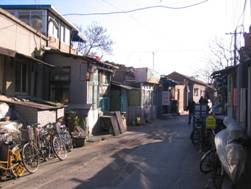


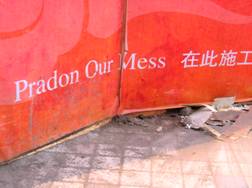
Beijing, bill board city. While China is developing at breakneck speed, the 2008 Olympics in Beijing make it even crazier. Behind fancy bill boards, whole neighbourhoods are torn down, to be replaced by high appartment buildings and shopping malls. But if you're fast you can still see some old neigbourhoods.

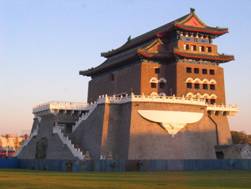
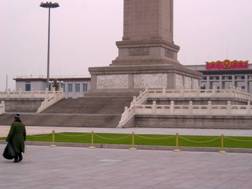


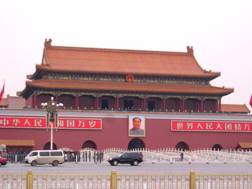
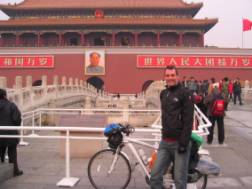
Beijing, Tianmen square. Supposedly the largest city square in the world, with Mao's mausoleum and other communist-style buildings, and where some years ago the bloody demonstrations took place.


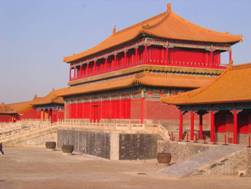
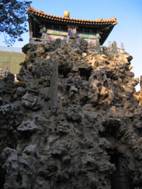

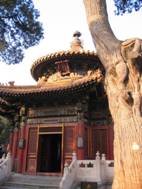


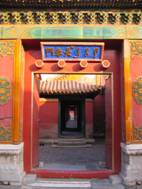


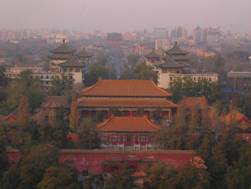
Beijing, the forbidden city.
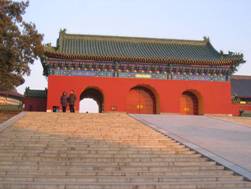

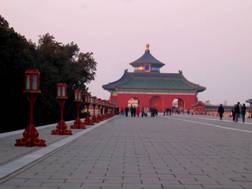

Beijing, the Temple of Heaven.

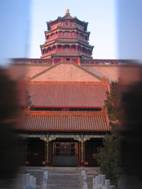

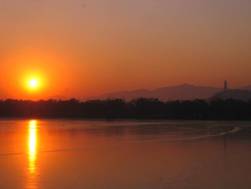
Beijing, the Summer Palace.


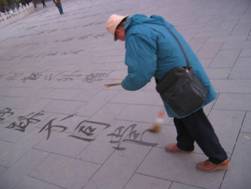
Beijing, parks. Old Chinese like to exercise in the park, or play with their toys.


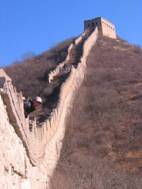


The Great Wall. I visited a not yet restored part of the great wall near Beijing. Of course you can't see it from the moon, but it is big all right.




Beijing furthermore. I went to a very beautiful Kung Fu ballet show, and did a lot of Christmas shopping, so don't break your back lifting the boxes, mum, it's 27 kg all together!
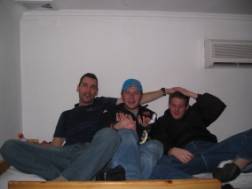
And last but not least, Bejing was rounded of with some good clubbing.


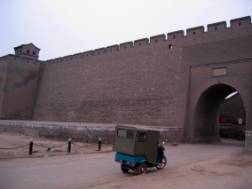

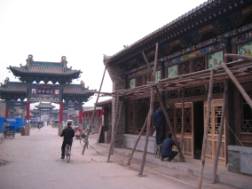
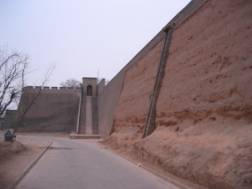

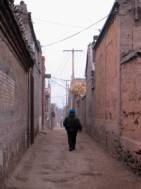


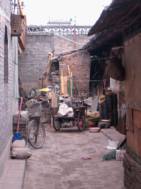

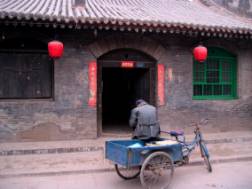

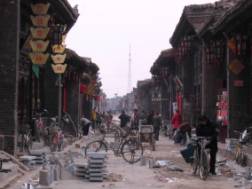

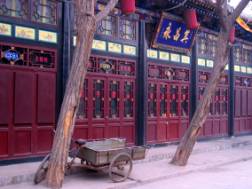
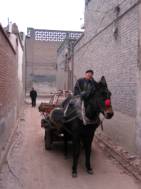


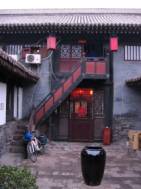
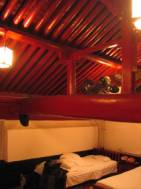
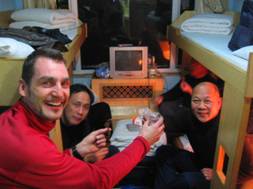
Pingyao walled city. Since I was not allowed to take my bicycle on the train, I took a night bus which had 'real' beds in it, three rows with two levels, with my bike squeezed into a corridor.
When they dropped me of at the highway and I bicycled towards the city in the freezing morning darkness, I could not find the city center of Pingyao until I realised after a lot of cycling around that all the city lights were hidden behind the city walls, ha ha, one of the last remaining in China.
When I finally found a gate in the walls and entered, they shut off all lights inside the city so I couldn't find a hostel until the sun came up, haha.
Most of the buildings of Pingyao have yet to be restored, so walking around here gives a good impression about how things must have been in the old days. Very authentic and tourism has just started, but within a few years this place will probably be just completely restored souvenir shops and hotels, so hurry.


My first Chinese train ride. Leaving Pingyao, the bus and train companies must have changed rules overnight, because the bus was suddenly heavily charging my bicycle, and it suddenly was possible to take the bike on the train, so I took my chances and tried the night train:
- My bike had to be weighed and checked in as cargo half a day before the train ride, and maybe it was even travelling on another train.
- At two o' clock in the night I woke up with a big BANG: the train had just rammed a big coal truck. Fortunately we didn't derail but it was a big mess nevertheless. After a few hours of hammering the train and rails and shuffing coal, the journey could be resumed.
- Probably due to the crash, a water pipe started to leak and soon our carriage was flooded.
- But these were all minor incommodoties compared to the horrible Chinese music and all the Chinese ignoring the non-smoking sign.
- The day after I could pick up my bicycle from the train station.
Hurrah for Chinese railways.




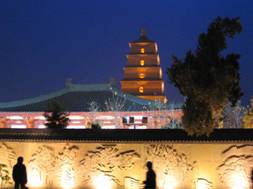

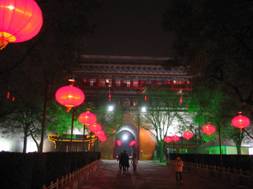
Xi'an city. Big city with a walled city center as well, and one of the largest fountains of the world with great shows.

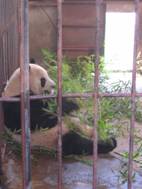


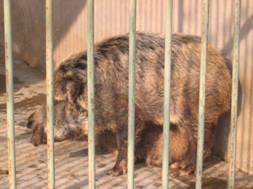


Xi'an Giant Panda's. There are only about a thousand Great Panda's left, amongst others because it is a very picky animal: it practically only eats bamboo, and not just any bamboo but only 20 of the 300 bamboo varieties in China. Moreover, they live solitary most of the year and have to find each other in the mating season, and dare to be even very particular in their partner choice, no wonder they are almost extinct.
I went to check 'm out in a so called 'rescue center', which turned out to be the saddest zoo I have ever seen. I'm not exactly an animal activist but I was outraged: all animals were in empty cages, a monkey was chained inside a cage, a yak-like was walking on his front knees with claws of over half a meter, our bus driver was throwing stones to get the animals to move, etc.
The last pictures show other sad animals: skinned leopards and wolfs, tiger claws, and painted poodles.
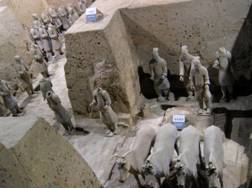


Xi'an terra cotta warriors.. Sometimes called the 8th wonder of the world, the army of terra cotta warriors. Very touristy but still impressive. And the excavations are still going on...


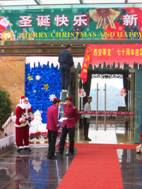
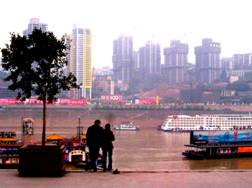
Chongqing..
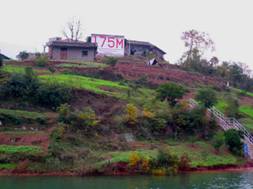
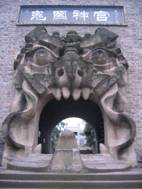


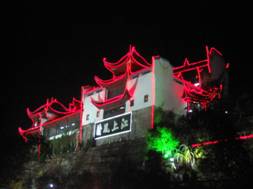


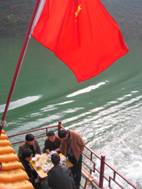

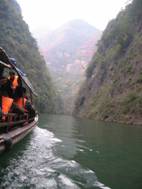


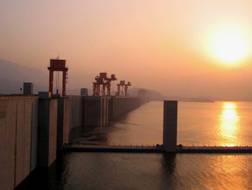
Yang-Tze river and Three Gorges dam. I took a 3 day cruise on the Yang-Tze river, and visited some very tacky tourist sites, not recommendable. The notorious Three Gorges dam has already risen the water up to the to top level of 175 m indicated along the river, the unique Yang-Tze dolphins are already extinct, and more environmental impact is yet to come. But with the dam the Chinese can generate 18MW power without burning coal.

Wuhan..
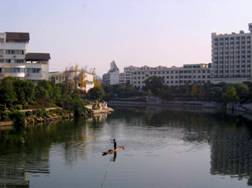


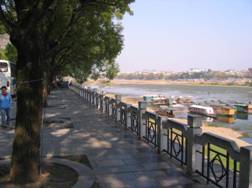
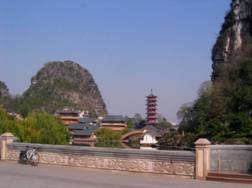

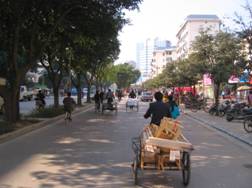
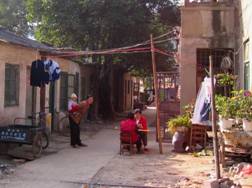
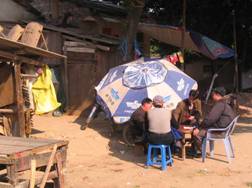
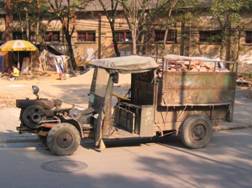
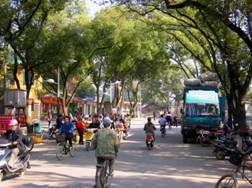
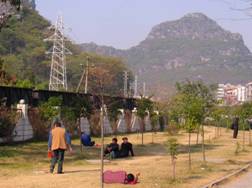



Guilin. It must be the wetter which makes everything seem better in this delightfull city in the south: the sun is shining, there is no smog, everyone is bicycling (or using an electric moped), people are very friendly, and the city looks gorgious with its canals and hills. My favorite city in China so far.
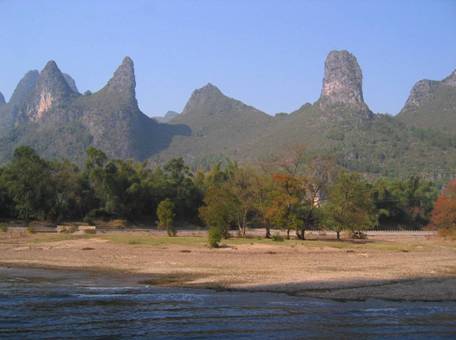

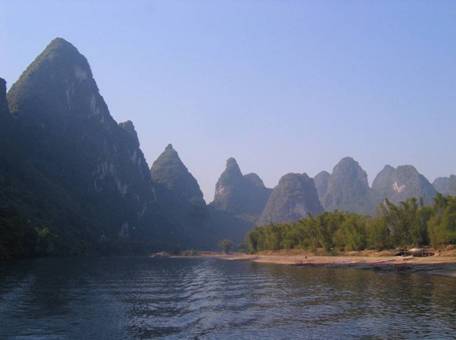


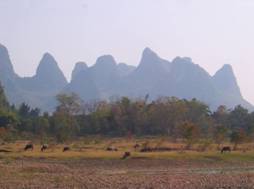

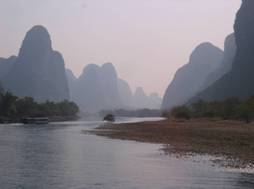
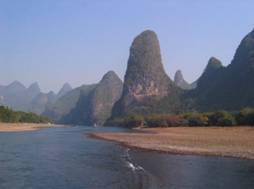

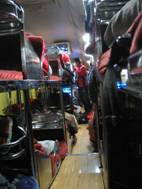
Li river. I took a river cruise from Guilin to Gangzhou, with its famous hilly scenery, which I found the most beautiful spot of China so far.


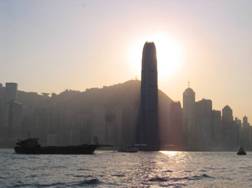



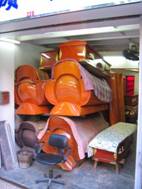

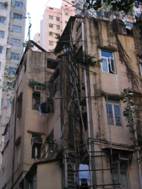

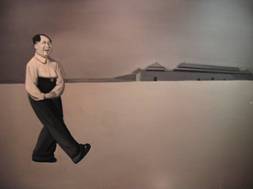
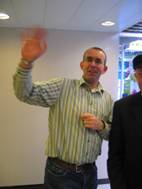
Hong Kong.. Former British colony, lots of skycrapers and islands. I visited Sjoerd and Esther, old colleagues from the Plaza Futura, and now living in Hong Kong for already 11 years. And in the subway I bumped into Joeri van Oosterhout.

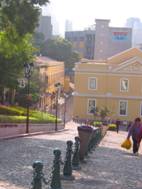

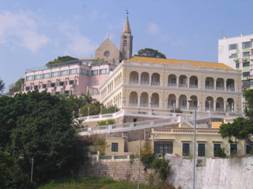
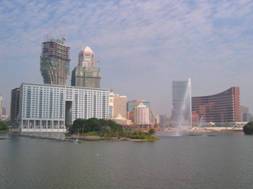

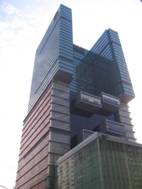

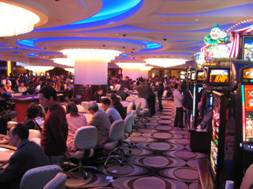
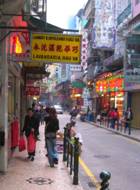
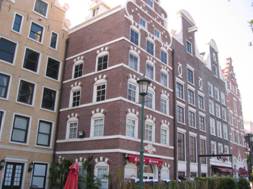

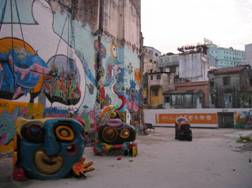
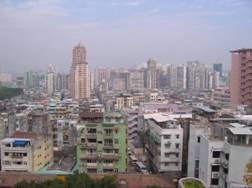


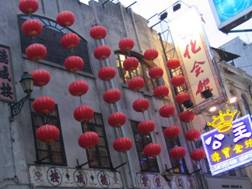

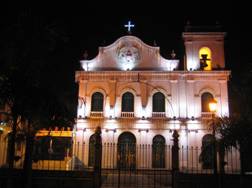
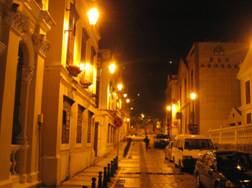

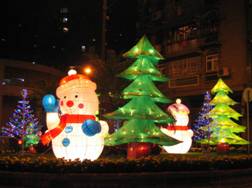

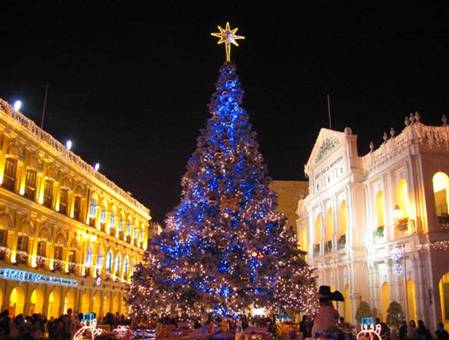
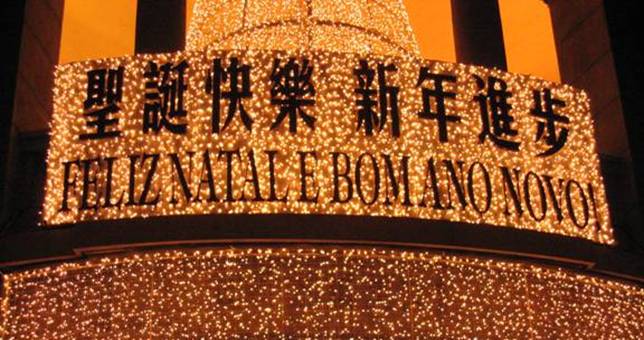
Macau.. A little former Portugese colony, now the Las Vegas of China, with some fancy casino's and less tasteless entertainment. Just like Hong Kong, Macau has recently been handed back to China, but for the coming 50 years it is still a separate country.
Nov 24: ferry; 25: Tanjin; 26-30: Beijing
Dec 1-5: Beijing; 6,7: Pingyao; 8-12: Xi'an; 13: Chongqing; 14-16: Yang-Tze river; 17: Wuhan; 18, 19: Guilin; 20, 21: Hong Kong; 22, 23: Macau; 24: Bangkok; 25: London; 26: Amsterdam
top of page
Netherlands break 2006
homepage